
How Much Should a Teenager Save? (A Realistic Guide for 2026)
Curious what your savings become by 30? Run them through the compound interest calculator.
The short answer: save at least 10% of every dollar you earn, build a $500-$1,000 emergency fund first, and aim to have $2,000-$5,000 banked by the time you turn 18. This guide covers the exact savings targets for teens, how to split your money using the 50/30/20 rule, what to save for at each stage, and how to actually hit your goals. Whether you have a job or not, there is a savings plan that works for you.
What Percentage of Their Income Should a Teenager Save?
Teenagers should save a minimum of 10% of any income they receive, including allowance, gifts, and part-time job earnings. A savings rate of 20% is better if you have a specific goal in mind, like a car or college costs.
Saving a percentage rather than a fixed dollar amount is the smarter habit to build. If you work more hours, you save more automatically. If you work fewer hours, you still save something. The habit matters more than the exact number at this stage.
Here is a quick breakdown of what those percentages look like on a typical teen income:
If you earn $200/month from a part-time job or allowance: 10% = $20 saved, 20% = $40 saved.
If you earn $500/month from a part-time job: 10% = $50 saved, 20% = $100 saved.
If you earn $1,000/month working regularly: 10% = $100 saved, 20% = $200 saved.
Those numbers add up fast. Saving $100/month for two years means $2,400 saved, before any interest or extra earning.
How Much Money Should a Teenager Have Saved by Age 18?
A teenager who reaches 18 with $2,000-$5,000 saved is in a strong position. If you are planning to go to college or university, aiming for $3,000 or more before you start is even better, since the average college freshman faces roughly $1,400 per month in living expenses.
To put this in perspective, research from Kids’ Money shows that among teens who have a savings account, 31% have more than $1,000 saved. Only 23% have less than $250. The average teen savings balance sits between $548 and $720.
There is no amount that is “right” for every teenager. Your target depends on what you are saving for. But having something saved, consistently, matters far more than hitting a specific number at any given age.
How Much Should a Teenager Save Per Month?
There is no universal monthly savings target for teenagers, because it depends entirely on how much you earn. The right goal is always a percentage of your income, not a fixed number someone else set for you.
That said, here are realistic starting points by income source:
Allowance only ($10-$30/week, or $40-$120/month): Save $10-$25/month. That is not a lot, but over four years of high school it adds up to $480-$1,200 with no job at all.
Part-time job ($500-$800/month): Save $75-$160/month at a 15-20% rate. Over two years that is $1,800-$3,840 saved.
Regular work plus allowance ($800-$1,200/month): Save $120-$240/month. Over two years that is $2,880-$5,760, which is life-changing money at 18.
According to Till Financial, the average weekly allowance for teens in 2026 is $17, with a median of $10. That is a place to start, not a reason to give up.
What Should a Teenager Be Saving For?
Teenagers save most effectively when they have a specific goal attached to their money. Saving without a reason makes it too easy to spend. Here are the four categories worth building toward, in order of priority:
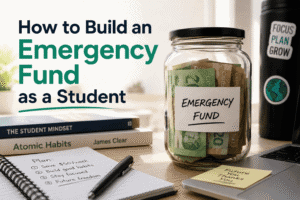
1. Emergency fund ($500-$1,000). This is your first savings goal, before anything else. An emergency fund covers unexpected costs like a broken phone, a car repair, or a medical bill, so you do not have to borrow money or wipe out your other savings. Start here and keep this money separate.
2. A specific short-term goal (3-12 months). This might be a new phone, a trip with friends, a gaming setup, or concert tickets. Short-term goals make saving feel real and rewarding. Every time you hit one, the habit gets stronger.
3. A medium-term goal (1-3 years). A car, a laptop for school, or a year of living expenses before university are all medium-term goals. This is where most of your savings should go once your emergency fund is covered.
4. Long-term savings (the future). Opening a TFSA (if you are Canadian and 18+) or a Roth IRA (U.S.) as soon as you are eligible is one of the smartest money moves you can make. Time in the market at 18 is worth more than almost any other financial decision you will make in your 20s. Build your financial skills by reading our guides to credit cards for students and creative ways to pay off student loans before you need either one.
How to Save Money as a Teenager Without a Job
You do not need a job to build a savings habit. You need a consistent income source and the discipline to save a percentage of it every time.
If you receive an allowance, treat 10-20% of it as untouchable the moment it lands in your account. Transfer it to a separate savings account immediately. Out of sight, out of mind.
Other income sources for teens without a traditional job include selling items on platforms like Depop, Vinted, or aBay. A quarter of teens and kids already earn money this way. Other options include babysitting, dog walking, lawn care, tutoring younger students, and doing odd jobs for neighbours. These income streams are inconsistent, but they are real.
The bigger win here is cutting spending. Apply the 72-hour rule to any purchase over $50: wait three full days before buying it. Most of the time, the urge passes. What feels urgent on Tuesday usually does not feel urgent by Friday.
How to Save More When You Have a Part-Time Job
Having a part-time job is a real advantage, and the biggest mistake teenagers with income make is spending everything before they save anything. The fix is simple: automate your savings the day you get paid.
Set up an automatic transfer to a separate savings account for the same day as your paycheck. Even $50 per paycheck adds up to $1,200 a year if you are paid biweekly. You will adjust your spending to whatever is left, rather than saving whatever is left after spending.
Some other habits that make a real difference:
Pack your own lunch. Buying food every shift is one of the fastest ways to drain a paycheck. Three shifts a week at $10 per meal is $120/month, or $1,440 a year.
Track where your money goes. You do not need a complicated app. A simple note on your phone with income and spending categories is enough. Most people who track spending naturally spend less.
Avoid lifestyle inflation. When you get a raise or pick up extra shifts, save the increase rather than spending it. This single habit separates people who build wealth from people who just earn more and spend more.
The 50/30/20 Budget Rule for Teenagers
The 50/30/20 rule is a budgeting framework where 50% of your income goes to needs, 30% goes to wants, and 20% goes to savings. It works for adults and it works just as well for teenagers.
For most teenagers, “needs” are smaller than they are for adults (you likely do not pay rent), which means you can actually save more than 20% if you choose to. Many teens can put 20-30% toward savings while keeping wants at 30% and needs at 50%.
Here is what 50/30/20 looks like on a $600/month income:
Needs (50% = $300): Transportation to work, phone plan contributions, school supplies, any household contributions your family asks for.
Wants (30% = $180): Eating out, entertainment, clothing beyond basics, subscriptions, hobbies.
Savings (20% = $120): Straight into a separate savings account, automatically, the day you get paid.
You can adjust these percentages based on your situation. The structure is what matters, not the exact splits. For a deeper look at budgeting, the Consumer Financial Protection Bureau has practical tools built for teens and young adults.
What to Look for in a Savings Account for Teenagers
A teen savings account should have no monthly fees, no minimum balance requirements, and offer a decent interest rate. A few extra features make a real difference in building the savings habit.
Look for accounts that let you set up automatic transfers from a chequing account. This is the single most effective savings tool available. If the money moves before you see it, you are far less likely to spend it.
High-interest savings accounts (HISAs) at online banks often offer rates well above what major bank branches offer. Rates change frequently, but a quick search for “best teen savings account” in your country will show current options. In Canada, check accounts at EQ Bank or Simplii. In the U.S., check out accounts at Ally or Capital One 360.
If you are under 18, most accounts require a parent or guardian as a co-signer. That is normal and does not limit what you can do with the account day-to-day. Understanding how savings accounts work is a foundational skill. You can build on it by learning how student loans work and what debt actually costs before you need that knowledge.
Frequently Asked Questions
How much money should a 16-year-old have saved?
A 16-year-old with any income should aim to have at least $500-$1,000 in savings as a starting emergency fund. Beyond that, saving 10-20% of every dollar earned is more important than hitting any specific total. A 16-year-old who saves consistently for two years will arrive at 18 with $1,000-$5,000, depending on how much they earn.
Is $1,000 a lot of money for a teenager?
Yes, $1,000 is a meaningful amount for a teenager, and most teens do not have it. Research shows 43% of teens with savings accounts have less than $500 saved. Reaching $1,000 puts you ahead of most of your peers and gives you a real financial cushion for unexpected expenses.
Should a teenager save all of their money or spend some?
Teenagers should save a portion of their money, not all of it. Saving 10-20% and spending the rest on needs and wants is a healthy balance. Trying to save 100% is unrealistic and usually backfires. The goal is to build a sustainable habit, not to deprive yourself of everything.
What is the best way for a teenager to start saving money?
The best way for a teenager to start saving is to open a separate savings account and set up an automatic transfer for 10-20% of every paycheck or allowance payment. Keeping savings separate from spending money removes the temptation to dip into it. Starting with a small, achievable goal like $500 makes the habit feel real and worth continuing.
Last updated: May 2026
Robert Puharich is the founder of TeenLearner, where he helps teens build real-world skills in money, AI, and life. With over 20 years in education and a Master of Education (M.Ed.) from UBC, he created TeenLearner to teach practical skills such as budgeting, career readiness, decision-making, and the wise use of technology. Robert is also a published author and business founder.