

According to a 2024 TD survey, 65% of Canadian post-secondary students describe themselves as financially unstable, and nearly half cannot adequately cover basic needs like food and housing. A separate Statistics Canada report found that 26% of Canadians could not cover an unexpected $500 expense in fall 2022. For students living on tight budgets with little room to absorb a shock, the gap between financial stability and a crisis can be as small as one car repair or one missed shift.
An emergency fund is the simplest tool for closing that gap. It does not require investing knowledge, a high income, or a complicated system. It requires a separate account, a realistic savings target, and consistent deposits. This article explains how to build one as a student, starting from zero.
The information in this article is for educational purposes only and does not constitute financial or tax advice. Consult a qualified financial adviser or the Canada Revenue Agency for guidance specific to your situation.
Key Insights
- A $500 emergency fund prevents most common student financial crises without requiring months of saving to get started.
- The fund only works if it is in a separate account you do not use for regular spending.
- Replenishing the fund after using it should be the first financial priority before any other goal resumes.
What an Emergency Fund Actually Is
An emergency fund is money set aside specifically for unexpected, necessary expenses. The key word is unexpected. A planned trip is not an emergency. A concert you did not budget for is not an emergency. A medical bill, a broken laptop before finals, a car repair that is required for work, or a lost job are emergencies.
The purpose is not to grow wealth. The purpose is to prevent a single unexpected event from derailing everything else: your academics, your living situation, your part-time income, your credit. Without this buffer, even a small financial shock can force students into high-interest debt or into decisions that affect their schooling.
A survey by Leger found that 26% of Canadian students aged 17 to 26 had considered dropping out of their program because of money. An emergency fund is the simplest way to take that outcome off the table.
How Much Do You Actually Need?
Standard financial advice says three to six months of living expenses. For most students, that target is too large to feel achievable and too far away to motivate consistent saving. A more practical approach is to set a first-stage target and build from there.
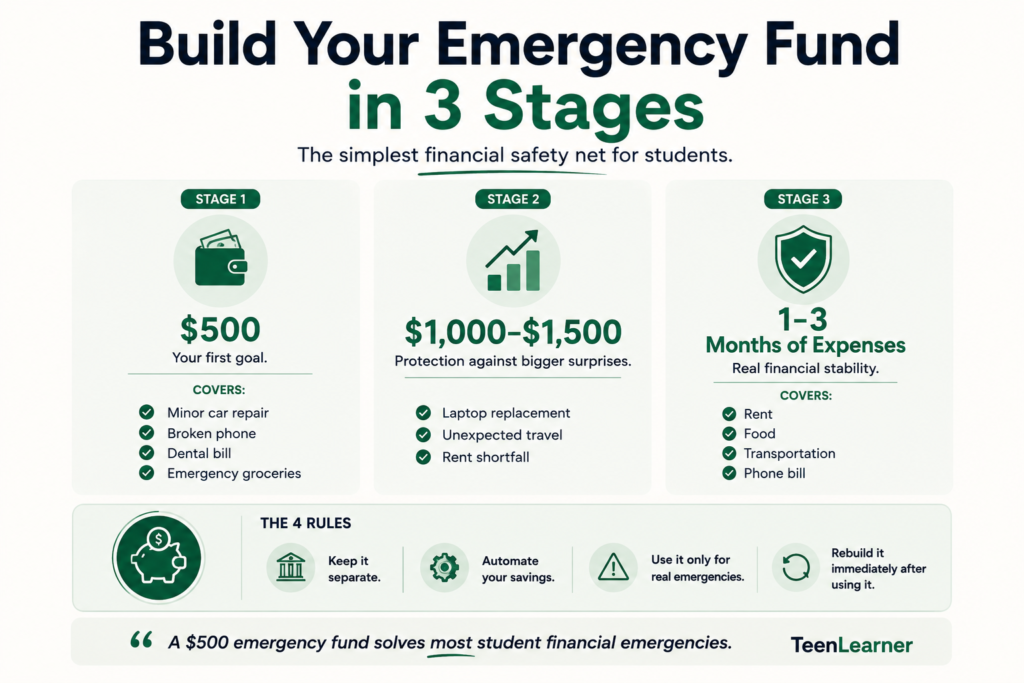
Stage one: $500. This amount covers most common student emergencies, including a minor car repair, a dental bill, replacing a broken phone, or one month of groceries if income drops suddenly. Getting to $500 is faster than most students expect. At $50 per month, it takes ten months. At $100 per month, it takes five.
Stage two: $1,000 to $1,500. Once the first stage is in place, extend the fund to cover larger expenses like a laptop replacement, a month of rent if a roommate leaves unexpectedly, or a flight home in a family emergency. This range covers the vast majority of financial emergencies a student is likely to face.
Stage three: one to three months of core expenses. If your monthly essential costs (rent, food, transport, phone) total $1,200, then a one-month buffer is $1,200 and a three-month buffer is $3,600. This level provides real stability. Most students reach it gradually, over a year or two of consistent saving.
The goal at any given time is simply to be in a higher stage than you are now. Not everyone needs three months of savings immediately. Everyone benefits from having $500 set aside before anything else.
Where to Keep It
The account you choose matters more than most students realize. The wrong account makes the fund too easy to spend accidentally or too tempting to raid for non-emergencies.
Keep the emergency fund in a separate savings account from your everyday spending account. Not a different tab in the same app — a different account entirely, ideally at a different institution or at minimum with a different login. Out of sight reduces the temptation to transfer it for something that is not a real emergency.
A high-interest savings account (HISA) is a good option. Canadian banks and credit unions offer HISAs with interest rates that meaningfully exceed standard savings accounts, and the money remains accessible within one to two business days. Rates change often and promotional rates are usually temporary, so compare ongoing rates on a site like Ratehub. Your emergency fund should never be locked into a GIC or investment account where accessing it requires fees or waiting periods.
Avoid keeping emergency savings in a TFSA if you are also using that account for long-term investing. While a TFSA is tax-sheltered and appropriate for the purpose, mixing emergency cash with investment funds creates confusion about what is available to spend. A dedicated, labelled account makes the purpose clear.
How to Build It on a Student Income
The most common reason students do not have an emergency fund is not a lack of income. It is a lack of an automatic process. When saving depends on remembering to transfer money at the end of the month, it usually does not happen. What is left after spending gets spent.
Set up an automatic transfer from your chequing account to your emergency savings account the same day your pay or student funding arrives. Even $25 or $50 per deposit builds the fund without requiring willpower or ongoing decisions. Treat it like rent: it goes out automatically and is not available to spend.
Find one or two specific reductions in variable spending that fund the transfer. Many students find that reducing eating out by two or three times per month frees up $40 to $60. Cancelling or pausing one streaming subscription adds another $10 to $20. The goal is to identify where the money comes from, not to cut everything enjoyable from your life.
Windfalls are a legitimate way to accelerate the process. A tax refund, a birthday gift, a higher-than-expected shift week, or a bursary payment that exceeds your immediate costs can all go directly into the emergency fund. Getting to stage one with a windfall instead of monthly savings is entirely valid — the outcome is the same.
Students who work seasonally or whose income varies month to month should save a higher percentage during high-income periods and a lower percentage during low-income periods. A flat-dollar automatic transfer works better than a fixed percentage for variable income — knowing exactly what will transfer removes the decision from months when money is tighter.
When to Use It (and When Not To)
The clearest test for whether something qualifies as an emergency: is it unexpected, necessary, and time-sensitive? All three conditions should apply. A car that breaks down and is needed for work: yes. A last-minute concert ticket: no. A flight home because of a family medical crisis: yes. A flight home for a long weekend because you are homesick: probably not, unless there is a real urgency.
Using the fund for a genuine emergency is exactly what it is for. There is no reason to feel guilty about accessing it in a real crisis. The fund exists to be used. The only condition is that replenishing it becomes the first financial priority once the emergency has passed.
Do not use the emergency fund to avoid a difficult budget decision. If you overspent on dining out and are short on groceries at the end of the month, that is a budgeting problem, not an emergency. Using the fund to cover routine shortfalls trains you to treat it as a general buffer, which defeats its purpose. Over time, a fund that is regularly raided for non-emergencies stops providing protection.
The Replenishment Rule
Every time you withdraw from the emergency fund, your first financial goal becomes restoring it to the previous level. Not investing more. Not saving for something else. Restoring the buffer.
This matters because emergencies rarely come one at a time. A car repair this month and a dental bill next month is not unusual. A fund that was depleted in January and not restored leaves you exposed in February. The replenishment rule closes that exposure as quickly as possible.
When restoring the fund after a withdrawal, temporarily increase your automatic transfer amount until the fund is back to the target level. If your normal transfer is $50 per deposit and you need to restore $400, increasing it to $100 for four pay periods gets you there without waiting eight months.
Keep learning: long term financial planning for students, the money skills checklist for teens and saving money as a college student in Canada.
Once your safety net is growing, the next step is learning how to become financially independent as a student.
Frequently Asked Questions (FAQ)
Can I use my OSAP or student loan money as an emergency fund?
Technically yes, but it is not recommended. Student loan funds are intended for education costs and living expenses during school. Using loan money as an emergency buffer still means borrowing: the federal portion of your loan has been interest-free since April 1, 2023, but any provincial portion may charge interest, and every dollar must be repaid. A better approach is to treat a small portion of your living expenses budget as savings from the start, rather than spending the full loan amount and keeping nothing aside.
What if I have debt? Should I pay it off before building an emergency fund?
Build at least a small emergency fund first, even if you have debt. The reason is that without any buffer, the next unexpected expense goes onto a credit card, which adds to the debt you are trying to eliminate. A $500 emergency fund prevents that cycle from repeating. Once you have a basic buffer in place, focus most of your available dollars on high-interest debt before expanding the emergency fund further.
How do I avoid spending the emergency fund on things that are not emergencies?
Keep it in a separate account with friction to access it. A savings account at a different institution than your main chequing account adds one to two days of transfer time, which is enough to pause and ask whether the expense is actually an emergency. Naming the account clearly (for example “Emergency Only”) also helps. The more inconvenient access is, the less likely you are to use it casually.
How do I start if I have almost no money right now?
Start with whatever amount will not leave you short on essentials. Even $10 or $20 per week moves the needle. Open the account now and transfer something today, even if it is small. The account existing and being active matters more than the initial amount. Many students find that once the account is open, adding to it becomes a habit faster than they expected.
Start today, not when things feel more stable. Open a separate savings account, set up a transfer for whatever amount you can manage consistently, and label it clearly. Financial stability as a student does not require a large income. It requires a small, protected buffer that is there when something goes wrong.
If you found this article useful, join the TeenLearner newsletter for more practical guides on earning money, building skills, and managing your finances as a teenager. New articles go out every week, written specifically for teens who want to get ahead before they graduate.