

Taxes for Teenage Income | Do I need to File a Tax Return?
This is educational information, not financial or tax advice. For your specific situation, consult a tax professional or the Canada Revenue Agency.
You worked a retail shift, made some DoorDash deliveries, sold a few things on Etsy, or maybe all three. Now a T4 slip showed up and someone is saying the word “taxes.” This guide is for you not your parents, not a general adult audience written specifically for Canadian teens figuring out their first tax return.
Key Insights
- Most Canadian teens are not required to file a tax return, but filing almost always results in a refund.
- Wealthsimple Tax is free for Canadians and handles most student returns in under an hour.
- Tuition credits reduce what you owe and carry forward to future years when your income is higher.
- Filing through the CRA’s NETFILE program is secure, direct, and faster than mailing a paper return.
Here is the honest answer: most Canadian teenagers do not legally have to file a tax return. But filing anyway, even if you earned very little, is almost always worth it. Most teens who file get a full refund of everything deducted from their paycheques, start building RRSP contribution room, and unlock government benefit payments they would otherwise miss. This guide breaks down exactly when you have to file, when you should even if you do not have to, and how to do it free in under an hour.
Do Canadian Teenagers Have to File Taxes?
In Canada, you are required to file an income tax return if you owe the government money. For most teens, that comes down to how much you earned. The federal basic personal amount for the 2025 tax year is $16,129. If your income stays below that threshold, you will not owe federal income tax.
There are some situations where you must file regardless of income: if the CRA sends you a demand to file, if you disposed of investments or cryptocurrency for a gain, or if you earned self-employment income above $3,500 and owe CPP contributions. For most students working part-time at a retail job or restaurant, none of these apply.
But here is where things get interesting.
Why You Should File Even If You Don’t Have To
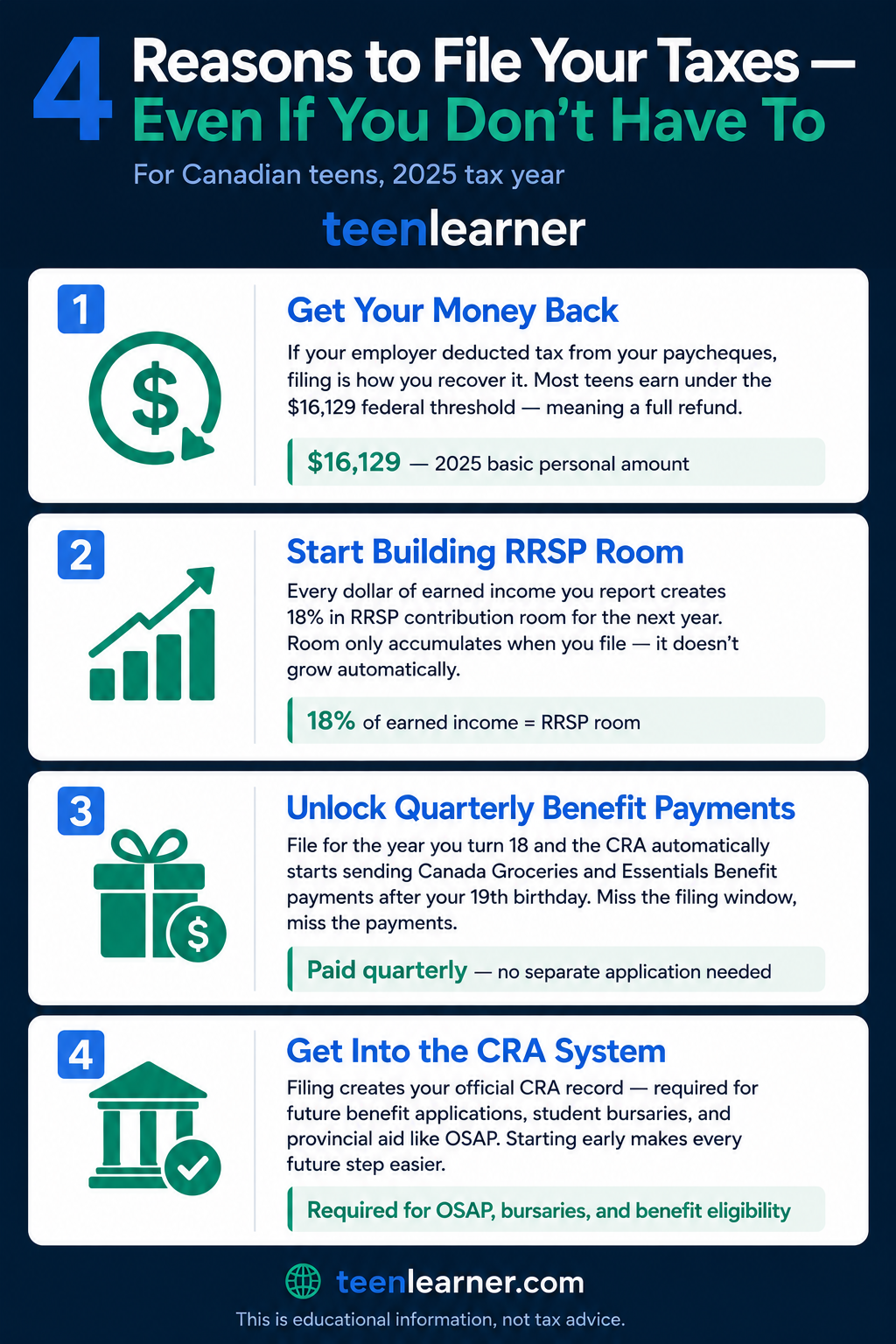
Filing a return when you are not required to is one of the smartest financial moves a teenager can make. Here is what you are leaving on the table if you skip it.
You could get money back. If your employer deducted income tax, CPP, or EI from your paycheques (which they almost certainly did), filing is how you recover that money. The CRA withholds tax based on estimates throughout the year. If you earned less than the basic personal amount, you are likely entitled to a full refund of every dollar deducted.
You start building RRSP contribution room. Every dollar of earned income you report creates 18% in RRSP room for the following year. You may not need an RRSP for years, but once you want the option, the room has to already exist. It only accumulates when you file. Our guide to TFSA vs RRSP for students breaks down how both accounts work and why most students should start with a TFSA first.
You unlock the Canada Groceries and Essentials Benefit. This quarterly payment (formerly the GST/HST credit) goes to lower-income Canadians who qualify. You become eligible the month after your 19th birthday, but the CRA automatically assesses you based on your filed return. File for the year you turn 18 and you receive your first payment shortly after turning 19 without having to apply separately. Miss that window and you miss payments.
You get into the CRA system. Filing creates your record with the Canada Revenue Agency, which matters for future benefit applications, student bursaries, and provincial student aid assessments like OSAP (Ontario Student Assistance Program). Getting registered early makes everything easier later. Once you are filing regularly and have money set aside, it is also worth reading about how much of your income to save each month so your refund actually goes somewhere useful.
What Counts as Teenage Income?
Any money you earn from work counts as income and needs to be reported. Here is a breakdown of the most common sources for teens.
Employment income from a regular job comes with a T4 slip. Your employer sends it by the end of February showing what you earned and what was deducted. You enter those numbers into your tax software and you are most of the way done.
Tips and gratuities are taxable income even when paid in cash and not on your T4. If you work in food service, you are expected to report what you receive. Many teens do not know this.
Gig economy work (delivering food through DoorDash or Uber Eats, selling on Etsy, or doing freelance design) is treated as self-employment income. You report it using Form T2125 and can deduct legitimate business expenses like a portion of your phone bill or transportation costs. If your net self-employment income exceeds $3,500, you also owe CPP contributions.
Interest income from savings accounts appears on a T5 slip from your bank if you earned more than $50 in interest. Money inside a TFSA is completely exempt. That is one more reason to keep your savings there rather than in a regular account.
How to File for the First Time
If your income is simple (a T4 from one job and maybe some tips), filing your first return takes less than an hour. Here is the process.
Step 1: Gather your documents. You need your Social Insurance Number (SIN), your T4 from your employer (check your mail or the CRA My Account portal), and any other slips: a T5 for bank interest, or a T2202 if you paid tuition at college or university.
Step 2: Create a CRA My Account. Go to Canada.ca and register for My Account. This lets you import your slips automatically via Auto-fill, check your refund status, and manage your tax history in one place.
Step 3: Use free tax software. Wealthsimple Tax is completely free for most students and connects directly to your CRA account to auto-fill your information. H&R Block and TurboTax also offer free versions for simple returns. All of these are NETFILE-certified, meaning you submit directly to the CRA online. No printing, no mailing.
Step 4: File by the deadline. The deadline to file your 2025 tax return is April 30, 2026. If you have self-employment income, your filing deadline extends to June 15, but any taxes owed are still due April 30.
Step 5: Set up direct deposit. If you are getting a refund, link your bank account in CRA My Account. NETFILE refunds typically arrive within two weeks.
Tax Credits Students Can Claim to Pay Less (or Get More Back)
If you are in college or university, a few credits can reduce what you owe or carry forward to years when your income is higher. The two most useful ones for students are the tuition tax credit and the student loan interest credit.
The tuition tax credit gives you a federal credit equal to 15% of eligible tuition fees paid to a qualifying institution. If you do not owe federal tax this year, you can carry unused amounts forward to future years when you do, or transfer up to $5,000 to a parent or grandparent. Note that Ontario, Alberta, and Saskatchewan no longer have provincial tuition credits. The federal credit still applies, but check your province.
The student loan interest credit lets you claim 15% of interest paid on your government student loans. If you are managing student debt, our guide on how student loans work in Canada covers the repayment side in more detail. You can find the full list of student-specific tax information on the CRA Students page.
Frequently Asked Questions (FAQ)
Does my part-time job income get taxed?
If you earn less than $16,129 federally in 2025, you will not owe income tax. But your employer likely still deducted tax from your paycheques throughout the year. Filing a return is how you get that money back as a refund.
What if I forgot to file last year?
You can still file. The CRA allows returns going back up to 10 years. If you were not required to file and owed no tax, there are no penalties. File when you can. The refund and benefit registration are worth it.
Do I pay taxes on babysitting or lawn-cutting money?
Technically yes, if it is consistent income. Occasional small amounts are rarely reported, but once it is a regular side business, the CRA considers it self-employment income. If you are earning regularly and tracking it, report it using Form T2125.
Can my parents file for me?
No. Once you are 18, you file your own return using your SIN. Your parents can absolutely help you prepare it, but the return is submitted in your name and authorized by you through NETFILE.
Last updated: May 2026
Robert Puharich is the founder of TeenLearner, where he helps teens build real-world skills in money, AI, and life. With over 20 years in education and a Master of Education (M.Ed.) from UBC, he created TeenLearner to teach practical skills such as budgeting, career readiness, decision-making, and the wise use of technology. Robert is also a published author and business founder.