

How to Make Money with AI as a Teen
Search “make money with AI as a teen” and you will find a predictable pattern. Someone shows a dashboard, mentions a few AI tools, then points you toward a course or newsletter.
The method in the video rarely makes money. The video about the method makes money. That business model is worth recognizing early.
What follows is not a how-to guide. It is an honest look at six AI-native income paths that are actually happening, what each one involves in practice, and what the economics look like when things go reasonably well.
What “AI-Native” Actually Means
Most income advice that mentions AI is really just describing a traditional job done faster with a new tool. Tutoring, virtual assistant work, and social media management existed long before ChatGPT.
AI-native income is different. These are paths where AI is not just speeding up the work. It is enabling something that either did not exist before or works at a fundamentally different scale because of it.
The six methods below all qualify on that basis.
Six Ways Teens Are Making Money With AI
1. Faceless Content Channels
Faceless channels are YouTube, TikTok, or Instagram accounts built with AI-generated scripts, voiceovers, and visuals, without the creator appearing on screen. The AI handles the production layer. The creator handles topic selection, quality control, and consistency.
The tools involved are all free at the starting level. ChatGPT or Claude for scripts, ElevenLabs free tier for AI voiceover, and CapCut for editing.
YouTube requires 1,000 subscribers and 4,000 watch hours before ad monetization begins. Most channels reach that threshold in six to eighteen months of consistent posting. Ad revenue in year one is modest, often a few hundred dollars at most.
Channels that grow beyond that earn through sponsorships and affiliate links, not ads. This is a long-term path, not a first income.
2. Video Clipping as a Service
Podcasters, streamers, and long-form YouTubers need short clips for TikTok and Reels but rarely have time to make them. AI tools can scan long videos, detect high-engagement moments, and generate rough cuts automatically. The human still decides which cuts are worth using and applies the finishing work.
Tools like OpusClip and Submagic have free tiers that make the detection and rough-cut stage accessible without upfront cost.
The skill being sold here is judgment, not just speed. Anyone can run a video through a clip tool. Knowing which thirty seconds will hold attention on a fast scroll is what clients are actually paying for.
3. Digital Templates Built With AI
Study planners, Notion dashboards, Google Docs outlines, and Canva content calendars are digital files that solve a specific problem for a specific buyer. AI speeds up the building process significantly. A template that might take four hours to design manually can be structured in under an hour when AI generates the skeleton, leaving more time to make it genuinely useful rather than generic.
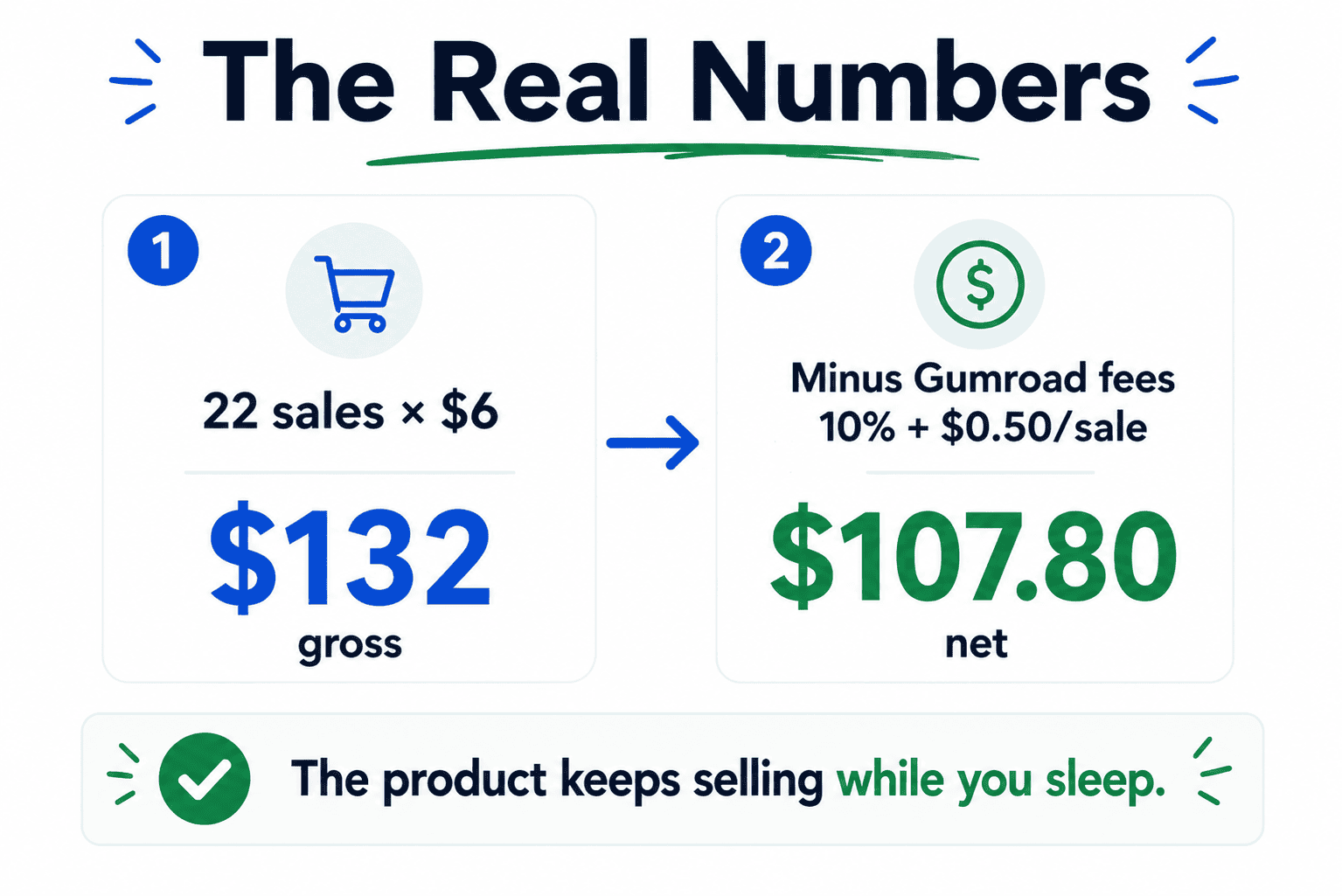
These sell on Gumroad and Etsy. To illustrate how the math can work, 22 sales of a $6 template generates $132 gross. After Gumroad’s fee of 10% plus $0.50 per sale, the seller keeps approximately $107.80. Results vary significantly depending on niche, platform, and how well the listing is written.
If you are looking for income methods that go beyond AI tools, the broader guide on earning money online as a student covers those options.
4. Writing and Ghostwriting With AI
Newsletters, blog posts, LinkedIn updates, and product descriptions are things small business owners need regularly but many cannot produce consistently. Teens with strong writing instincts can offer this as a service, using AI to produce first drafts faster and focusing their own effort on editing, tone, and accuracy.
This is not submitting AI output directly to a client. It is using AI to remove the blank page problem, then applying real editorial judgment to what comes out. The same principle applies in any context where AI is involved — understanding where the line is matters whether you are writing for a client or completing an assignment.
Platforms like Fiverr list hundreds of these services. Income varies widely depending on niche and client, and building a track record takes time. For someone with natural writing ability, this tends to have one of the lower barriers to a first paid project.
5. Print-on-Demand With AI-Generated Designs
Print-on-demand platforms like Redbubble and Printify let sellers upload designs that get printed on products when a customer orders. The platform handles production and shipping. The seller handles design and listing.
AI image tools, including the free tiers of Canva’s AI generator and DALL-E through ChatGPT, can generate original designs quickly. A creator focused on a specific niche, such as a particular sport, aesthetic, or community, can generate and upload multiple designs in a single session.
Income depends almost entirely on finding a niche with buyers. Broad designs compete with thousands of existing sellers. Specific, community-oriented designs find smaller but more loyal audiences. Most sellers see minimal sales for months before finding what works.
6. Chatbot Building for Small Businesses
Local businesses like gyms, salons, real estate agents, and restaurants increasingly want chatbots on their websites to answer common questions and capture leads. Most have no idea how to build one.
Tools like Voiceflow and Botpress have free tiers that make basic chatbot construction accessible without coding knowledge. A teen who can build a functional, polished chatbot and explain its value clearly has something a local business owner will pay for.
This path has a higher learning curve than the others on this list. Selling it also requires comfort with direct outreach to potential clients. It is one of the few options here where the work is project-based rather than platform-dependent, which means income is not tied to an algorithm deciding how many people see your listing.
What These Have in Common
None of these paths require a large following, an expensive setup, or prior business experience. All of them require actual work, and most take longer to generate consistent income than the average YouTube thumbnail suggests.
AI lowers the production barrier. It does not lower the judgment barrier. The teens who make progress on any of these are not the ones who picked the most promising-sounding option. They are the ones who stayed with one path long enough to understand why the first attempts did not work.
That patience is harder than any of the tools.
Many of the tools used across these methods, including ChatGPT, Claude, ElevenLabs, and CapCut, are the same free tools covered in the guide to free AI study tools for students. If you are still in school, that guide is worth reading first.
Frequently Asked Questions
Is it realistic for a teen to make money with AI in 2026?
It is realistic in the same way it is realistic to earn money with any other skill. It requires time, effort, and a willingness to improve based on what is not working. AI lowers some barriers around production speed and access to tools, but it does not remove the need to build something genuinely worth paying for.
Which of these is easiest to start with no experience?
There is no single answer that applies to everyone. Digital templates and writing tend to have the lowest technical barrier to a first attempt. Faceless channels and print-on-demand require more patience before results appear. Chatbot building requires the most learning upfront. The better question is which one is easiest to stay interested in for six months, because consistency matters more than the choice.
Do you need money to start any of these?
Most have a meaningful free starting point. Gumroad, Redbubble, and Etsy do not charge upfront fees. They take a percentage when something sells. ChatGPT, Claude, Canva, OpusClip, and ElevenLabs all have free tiers. The primary investment required to start is time, not money.
This article is for informational purposes only and does not constitute financial or business advice. Income from any of these methods is not guaranteed and varies significantly based on execution, market conditions, and individual effort. Always research platforms and tools independently before committing time or resources.
Want to learn how to use AI the right way while you are still in school? Subscribe to the TeenLearner newsletter and get one practical lesson delivered to your inbox each week.
Robert Puharich is the founder of TeenLearner, where he helps teens build real-world skills in money, AI, and life. With over 20 years in education and a Master of Education (M.Ed.) from UBC, he created TeenLearner to teach practical skills such as financial literacy, making better life choices, and the wise use of technology. Robert is also a published author and business founder.