

Budgeting for teens works best when it accounts for irregular income, because most teens don’t earn the same amount every month. This article covers five practical tips: tracking your spending before you write a single number, saving first before you spend anything, using a four-bucket system instead of rigid percentages, running a monthly subscription audit, and adjusting your budget when your income goes up or down.
Key Insights
- Most teen budgets fail because they’re built on income that never arrives on schedule, and the fix is to budget based on your lowest typical month, not your average.
- Paying yourself first (saving before you spend) is more effective than trying to save whatever is left over.
- A four-bucket system (save, fixed costs, goals, spending money) is simpler and more honest for teens than the 50/30/20 rule.
- The average teen with a smartphone has 3-5 paid subscriptions they rarely use. Auditing these monthly can free up $20-$50 immediately.
- You don’t need a complicated app or spreadsheet to budget. A simple notes app and a consistent habit beats a perfect system you never use.
Want to see your numbers instead of guessing? Plug them into our free budget calculator.
Why Most Teen Budgets Fail in the First Month
Most teen budgets fall apart quickly because they’re designed for a stable monthly income, the kind adults have with regular paycheques. Teen income doesn’t work that way. You might work 20 hours one week and zero the next, pick up a birthday cash gift in March, and earn nothing in August when you’re on vacation. A budget built on an assumed monthly income of $600 breaks immediately in a month where you only bring in $250.
The fix is to budget based on your minimum reliable income, not your average. Figure out the lowest amount you can realistically count on in a typical month, build your budget around that number, and treat anything extra as a bonus to direct deliberately. That way, a slow month doesn’t blow up your plan.
The second reason teen budgets fail is that they start with rules instead of reality. Writing down what you should spend before you know what you actually spend never works. The first step before budgeting anything is spending two weeks just watching where your money goes. No rules, no restrictions, just observation. That data is the foundation everything else is built on.
Tip 1: Track Your Spending for Two Weeks Before You Write Any Budget Numbers
The first budgeting tip for teens is to track every dollar you spend for two full weeks before creating any budget categories. Open your phone’s notes app, keep a simple list (date, amount, what it was for), and do it every time you spend money. No exceptions, no rounding.
After two weeks, add it up by category. Most teens find at least one or two categories that actually surprise them. Common ones: food and drinks (coffee, takeout, convenience store runs add up faster than almost anything), streaming and app subscriptions, and impulse purchases under $10 that feel trivial in the moment but total $40-$80 per month.
This two-week snapshot gives you real data to work with. Every budget number you set after this is grounded in how you actually live, not how you imagine you do. That makes the budget far more likely to hold.
If you want an app to do the tracking automatically, YNAB (You Need A Budget) offers a free trial and is widely used by first-time budgeters. A basic spreadsheet or even your phone’s notes app works just as well for this initial tracking phase.
Tip 2: Pay Yourself First: Save Before You Spend Anything Else
Paying yourself first means putting a set amount into savings the moment money comes in, before you spend a single dollar on anything else. This is the single most effective budgeting habit for teens, and it works because it removes the temptation to spend first and save what’s left, which almost never works.
The amount doesn’t have to be large to matter. On a $400/month income, saving $40-$80 first (10-20%) before anything else leaves $320-$360 for everything else. That savings account grows quietly whether you think about it or not. On a month where you earn $600, move the same percentage ($60-$120), and you’ve just given your savings a boost without changing your lifestyle at all.
Set this up as an automatic transfer if your bank allows it. The less you have to actively decide to save each month, the more consistently it will happen. Many Canadian banks and credit unions allow you to set up automatic transfers between accounts for teens who are 16 or older. Check with your specific institution about the minimum age for account setup. If you’re interested in how much you should be saving overall, this breakdown of teen savings targets is a useful starting point.
Tip 3: Use the Four-Bucket System Instead of the 50/30/20 Rule
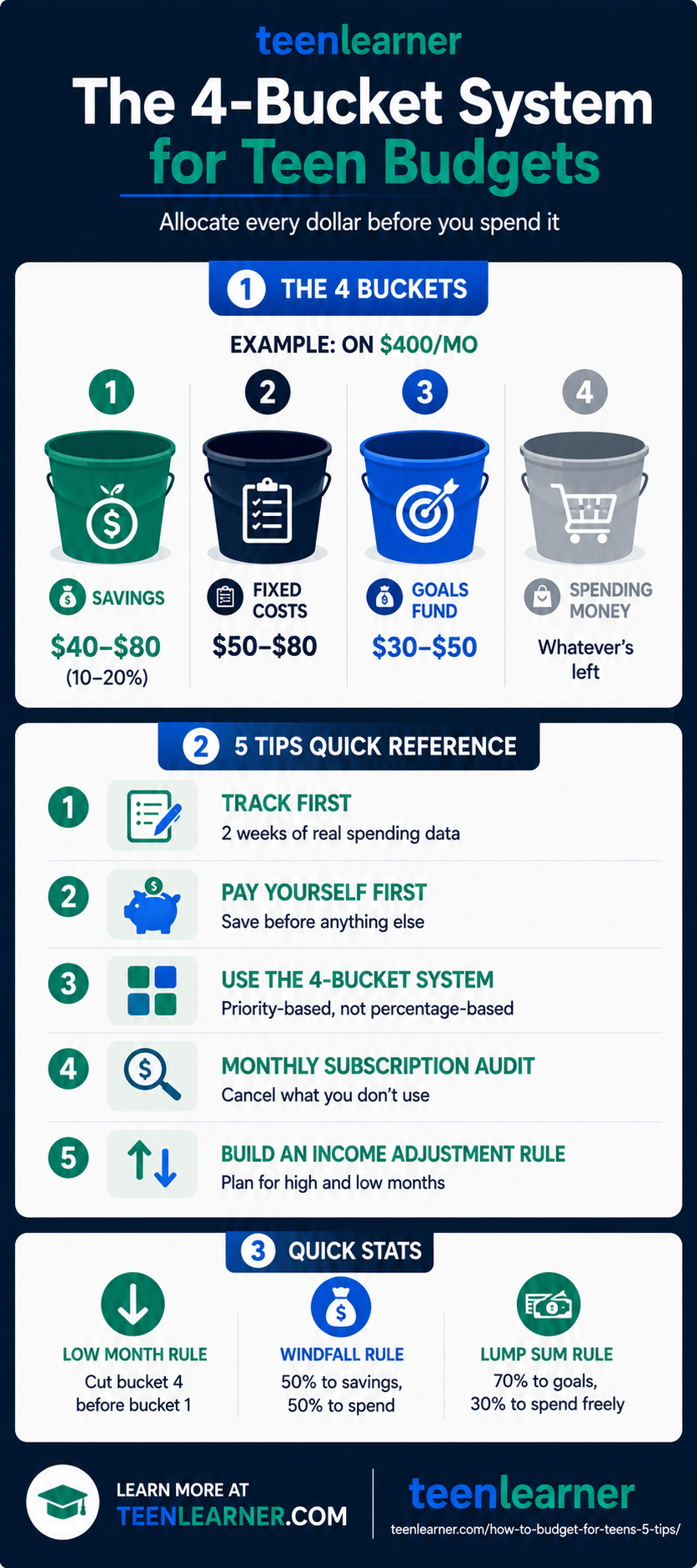
The four-bucket system divides your money into four categories in priority order: savings, fixed costs, goals, and spending money. It works better for teens than the 50/30/20 rule because it is priority-based rather than percentage-based, which means it holds up even when your income varies month to month.
Here is how each bucket works with a real example. Say your minimum reliable monthly income is $400.
Bucket 1: Savings (pay yourself first). Move 10-20% off the top immediately. On $400, that is $40-$80. This goes into a savings account you do not touch for daily spending.
Bucket 2: Fixed costs. These are the same every month: phone plan contributions, a transit pass, any subscription you actively use. On $400, this might be $50-$80. If your fixed costs are eating more than 20-25% of your minimum income, that’s a signal to cut something.
Bucket 3: Goals fund. Pick one or two specific things you are saving for: a laptop, a trip, a car fund, a first month’s rent. Set a dollar target and a timeline, then calculate how much per month gets you there. On $400, even $30-$50 per month toward a goal adds up: $50/month for 10 months is $500 toward a laptop.
Bucket 4: Spending money. Whatever remains after the first three buckets is yours to spend freely, no guilt required. On $400 with $80 saved, $60 in fixed costs, and $40 toward goals, you have $220 of spending money. Because you have already handled savings and goals, every dollar in this bucket is completely guilt-free.
The 50/30/20 rule is not wrong . It is a decent framework for adults with stable incomes. But it assumes you know your monthly income in advance and that your “needs” are always close to 50%. For most teens, neither of those is true. The four-bucket system adjusts automatically because you fill buckets 1-3 first, and bucket 4 absorbs any variation.
Tip 4: Do a Monthly Subscription Audit to Find Hidden Spending
A subscription audit means reviewing every recurring charge hitting your bank account or credit card each month and deciding whether each one is worth keeping. Most teens have at least three or four paid subscriptions, and usually one or two they forgot about entirely.
Common ones to check: streaming services (Netflix, Spotify, Disney+, Apple TV+), gaming subscriptions (Xbox Game Pass, PlayStation Plus), cloud storage upgrades, app subscriptions that started as free trials, and any in-app purchases that auto-renewed. These small charges are easy to miss individually but often total $20-$60 per month.
The audit takes about five minutes. Open your bank statement or card app, filter for recurring charges, and ask one question about each one: “Did I actually use this in the past 30 days?” If the answer is no or barely, cancel it. You can always restart it when you want it. Most services make reactivation easy precisely because they know people cancel impulsively and come back.
Do this audit on the first of each month. Treat it as a five-minute routine. The cumulative effect of consistently trimming one or two unused subscriptions each month adds up to real money over a year.
Tip 5: Build an Income Adjustment Rule for High and Low Months
An income adjustment rule tells you in advance what to do when you earn more or less than your baseline amount. Having this rule means you never have to make an emotional decision about a windfall or a shortfall in the moment. The decision is already made.
Here is a simple version that works for most teen situations.
In a low month (you earn less than your baseline): Fill buckets 1-3 first, even at a reduced amount. If you can’t fill savings at 15%, drop to 10% or even 5%, but do not skip it entirely. Cut bucket 4 (spending money) before cutting bucket 1 (savings). Spending flexibility is the buffer, not your savings habit.
In a high month (you earn more than your baseline): Split the extra intentionally before you spend it. A simple rule: 50% of anything above your baseline goes to savings or goals, 50% goes to spending money. So if you normally earn $400 and this month you earned $600, the extra $200 splits into $100 to savings/goals and $100 of extra spending money. This feels fair without being so restrictive that you never enjoy a good month.
For lump sums (birthday money, graduation gifts, tax refunds): Decide the split before the money lands in your account. A common approach is the 70/30 split: 70% toward savings or a specific goal, 30% to spend freely. Deciding in advance removes the temptation to spend first and figure out the rest later.
The Best Free Tools for Teen Budgeting in 2026
The best budgeting tool for a teen is whichever one you will actually use consistently. Complexity is the enemy of consistency. Here are the most practical options at different levels of effort.
Simplest (no app needed): A note on your phone. One running list of what you spent, reviewed once a week. Paired with a simple four-bucket allocation at the start of each month, this is all most teen budgeters need.
Step up (free app): Wealthsimple (Canada) lets you track spending connected to your account and save automatically. In the US, Google Wallet and many bank apps now offer built-in spending category breakdowns with no extra setup needed.
Most structured (paid but worth it): YNAB (You Need A Budget) uses a zero-based approach where every dollar is assigned a job before you spend it. It has a learning curve but consistently gets strong results for people who use it regularly. Students get a free year with a valid school email.
The tool matters less than the weekly habit of checking in. Even five minutes once a week spent looking at what you spent versus what you planned is enough to keep most teen budgets on track. If you are also thinking about where to put your savings once you have built them up, the basics of investing for high school students is a natural next step.
Keep learning: our Erika Kullberg interview.
Frequently Asked Questions About Budgeting for Teens (FAQ)
What is the best budgeting method for teenagers?
The four-bucket system (savings first, fixed costs, goals, spending money) is the most practical budgeting method for teens because it works even when income varies month to month. The 50/30/20 rule is a useful framework but assumes a stable income that most teens do not have. Any method works if you use it consistently. The best one is the simplest version you will actually stick to.
How much should a teenager save from each paycheque?
A realistic starting target is 10-20% of each paycheque, saved before spending anything else. On a $400/month part-time income, that is $40-$80 per month. The exact percentage matters less than the habit of saving first consistently. Starting at 10% and building from there beats starting at 30% and giving up after two months.
What should a teen include in their monthly budget?
A teen monthly budget should include four areas: savings (10-20% off the top), fixed monthly costs (phone plan, transit pass, active subscriptions), a goals0fund for specific upcoming purchases, and spending money for day-to-day expenses like food, entertainment, and clothing. Start with the first three and let spending money be whatever remains.
Is the 50/30/20 rule good for teenagers?
The 50/30/20 rule can work for teens with a consistent monthly income, but it breaks down quickly when income varies. Most teens earn differently each month depending on shifts, allowance, and occasional cash gifts. A priority-based system like the four-bucket method handles this better because it fills savings and fixed costs first and lets spending money absorb the variation, rather than requiring all three percentages to stay fixed every month.
Budgeting and saving go hand in hand. For the saving side of the equation, read our guide on how to save money as a teenager.
If you found this article useful, join the TeenLearner newsletter for more practical guides on earning money, building skills, and managing your finances as a teenager. New articles go out every week, written specifically for teens who want to get ahead before they graduate.