

This article is for educational and informational purposes only and does not constitute financial advice. TeenLearner is not a licensed financial advisor. Please consult a qualified financial professional before making any investment decisions.
You opened the TFSA. Maybe a parent walked you into the bank the week you turned 18, or maybe you tapped through a sign-up screen on your phone between classes. Now there is an account sitting there with $0 in it, and nobody told you what happens next.
That is the part most guides skip. They spend pages explaining what a TFSA is, then stop right where the real questions start. How much should the first deposit be? What do you actually hold inside it? What happens if you take money out for rent in September and want to put it back in November?
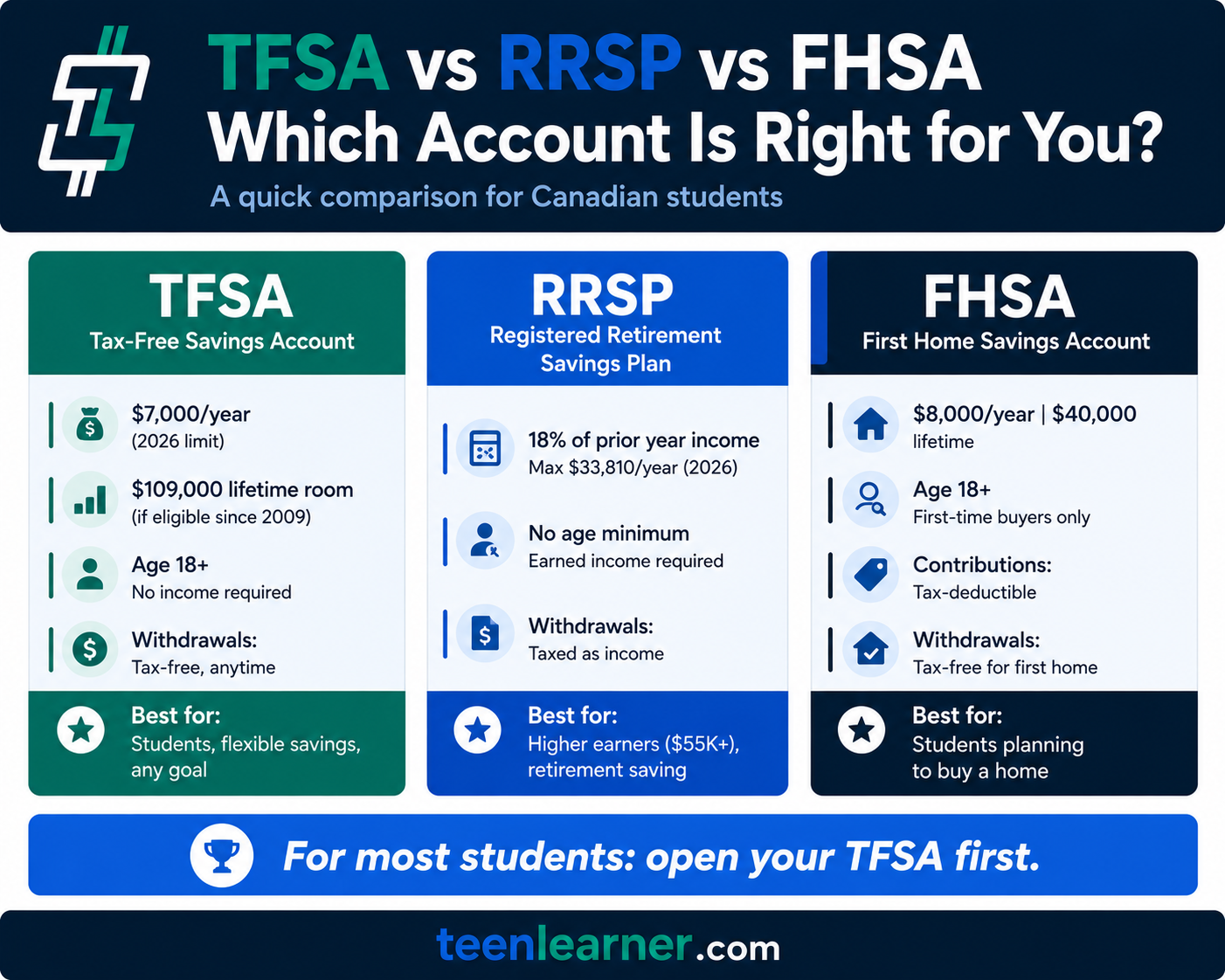
This playbook answers those questions for your first year. Using a TFSA well as a student comes down to five moves. Know your exact contribution room, make a first deposit you can repeat every month, match what you hold to when you need the money, track every withdrawal until January 1, and move money between institutions only by direct transfer. If you are still deciding whether a TFSA or an RRSP should come first, start with our TFSA vs RRSP comparison for students, then come back here once your account is open.
How Much TFSA Contribution Room Do You Have as a Student?
If you turned 18 in 2026, you have $7,000 of TFSA contribution room. If you turned 18 in 2025, you have $14,000, and if you turned 18 in 2024, you have $21,000, as long as you have been a Canadian resident and have not deposited anything yet.
Contribution room is the total amount you are allowed to deposit across all of your TFSAs combined. It starts building on January 1 of the year you turn 18, whether or not you have opened an account. The annual limit for 2026 is $7,000, the same as in 2024 and 2025.
In provinces and territories where the age of majority is 19, including BC, you may have to wait until 19 to open the account. The Canada Revenue Agency confirms you still keep the room from the year you turned 18, so nothing is lost by waiting.
The CRA’s contribution room formula is simple. Your room this year equals this year’s limit, plus unused room from past years, plus anything you withdrew last year, minus what you have already deposited this year.
Why the Number in CRA My Account Can Be Wrong
The room shown in CRA My Account can lag behind your real balance by several months. It is built from reports your bank or brokerage sends after the year ends, and the CRA says it typically finishes processing the previous year’s TFSA records by April.
So if you deposit $2,000 in March and check My Account in June, the number you see may not include that deposit. This is one of the most common ways first-year users accidentally over-contribute. The fix is to keep your own record. A note on your phone with the date and amount of every deposit and withdrawal is enough.
How Much Should Your First TFSA Deposit Be?
Your first TFSA deposit should be an amount you can repeat every month, not the biggest amount you can scrape together once. For most students with a part-time job, that lands somewhere between $25 and $100 a month.
If you bring home around $800 a month, a $50 monthly deposit is about 6% of your pay. That is small enough to keep up through exam season and slow months at work, which matters more than the size of any single deposit.
Consistency wins because of compound growth, where your earnings start earning money of their own. As an illustration, $100 a month for 10 years at a hypothetical 5% annual return grows to about $15,500 from $12,000 of your own deposits. Keep it going for 17 years, from age 18 to 35, and it reaches about $32,000 from $20,400 deposited. Returns are never guaranteed and investments can lose value, but the pattern holds. Time does most of the heavy lifting.
Set the deposit up as an automatic transfer for the day after payday. If you are not sure what number to pick, our guide on how much a teenager should save walks through realistic percentages.
What Should You Hold Inside Your TFSA at Each Stage?
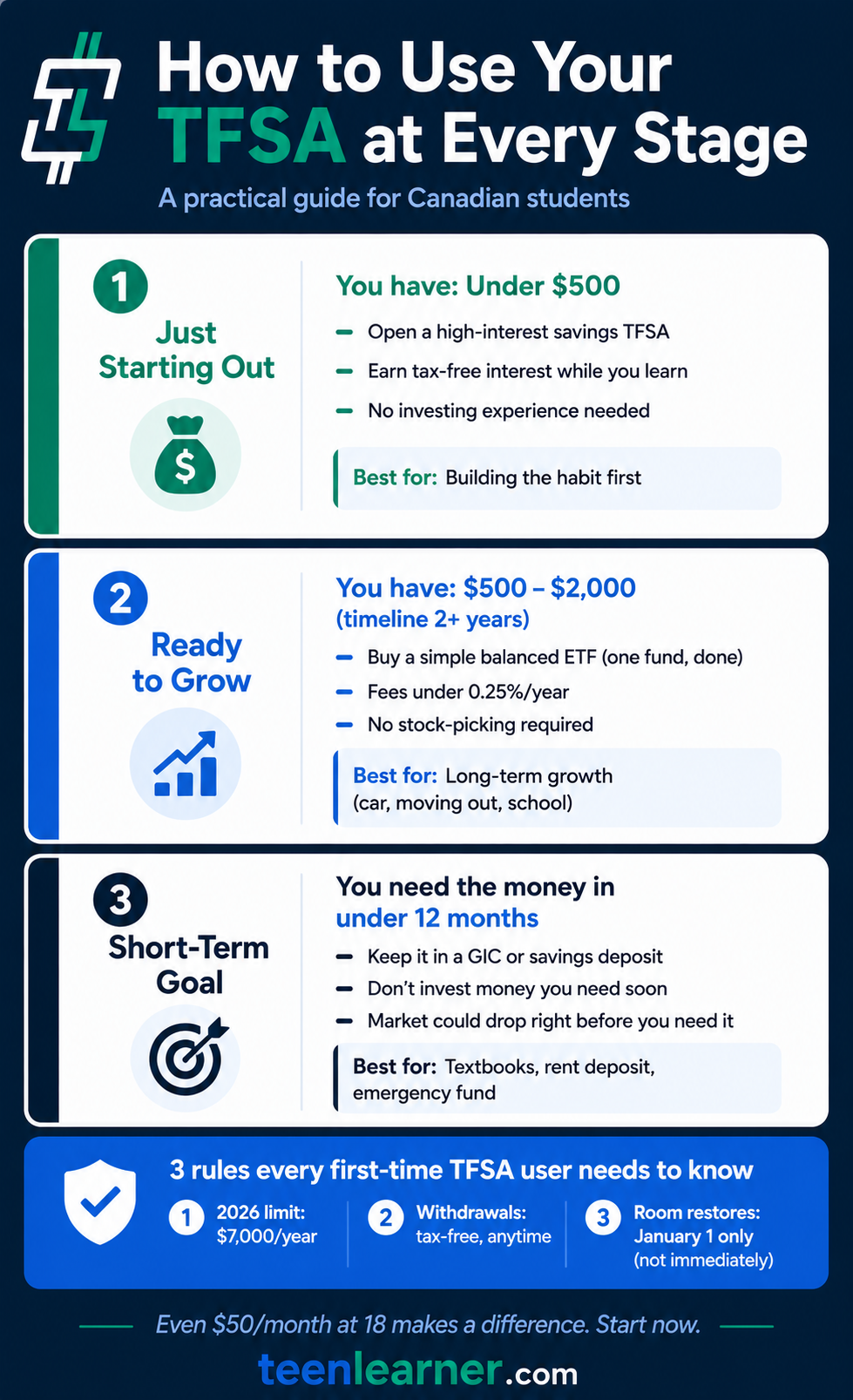
What you hold inside a TFSA should depend on when you will need the money. Money you need within about a year usually belongs in savings or a GIC, while money you will not touch for five years or more is where many beginners start looking at diversified investments.
A TFSA is a container, not an investment. Inside it you can hold cash, GICs, mutual funds, ETFs, stocks and bonds. The account itself does not grow your money. What you put inside it does, and everything it earns stays tax-free.
Under $500 While You Build the Habit
Keep it in a high-interest savings option inside the TFSA. The interest is tax-free, the money stays easy to reach, and you learn how deposits and room work before anything can drop in value.
$500 to $3,000 for a Goal in the Next Year or Two
If this money is for something specific, such as a car, a laptop, or first and last month’s rent, many students use a GIC. A Guaranteed Investment Certificate (GIC) is a deposit that pays a fixed interest rate for a set term, such as one year. Many GICs cannot be cashed early without a penalty, so only lock in money you will not need before the term ends.
Long-Term Money You Will Not Touch for Five Years or More
This is where financial educators commonly point beginners toward low-cost, broadly diversified index ETFs, which hold hundreds or thousands of companies in a single fund. They rise and fall with the market and can drop sharply in a bad year, which is why this bucket is only for money with a long runway. Our guide to investing in ETFs for beginners explains how they work.
Most students end up with a mix. Emergency cash in savings, a GIC for a known expense, and a small monthly amount going into long-term investments. If you do not have any emergency savings yet, build that first with our student emergency fund guide.
How Do TFSA Withdrawals Work for Students?
You can withdraw from a TFSA at any time, for any reason, without paying tax. The amount you take out is added back to your contribution room on January 1 of the following year, not right away.
Here is where students get caught. Say you have $7,000 of room in 2026 and deposit all of it by June. In September you withdraw $1,500 for textbooks and residence costs. In November a holiday bonus lands and you want to put that $1,500 back. If you do, you are over your limit, because that $1,500 of room does not return until January 1, 2027.
The CRA charges a tax of 1% per month on any excess amount for as long as it stays in the account. On a $1,500 over-contribution, that is $15 every month. If it happens, withdraw the excess right away rather than waiting for the CRA to contact you.
The rule to remember is short. If you have already used all your room this year, anything you withdraw stays out until January.
How to Move Your TFSA to a Different Bank or App
To move a TFSA from one bank or app to another, ask the new institution to do a direct transfer for you. Never withdraw the money and redeposit it yourself.
Plenty of students open a first TFSA at the bank where they already have a chequing account, then later want to switch to an app with lower fees, or the other way around. The CRA’s TFSA transfer rules are clear that a withdrawal followed by a deposit at another institution counts as a brand new contribution. If you do not have enough room for it, you have over-contributed.
A direct transfer, which the receiving institution starts for you, does not affect your room at all. You can usually move investments as they are (called an in-kind transfer) or sell them first and move the cash. Some institutions charge a transfer fee, so ask before you start.
Your First-Year TFSA Checklist
Your first year with a TFSA takes about an hour of setup and a few minutes a month after that. Here is the order to do it in:
1. Confirm your room. Add $7,000 for every year since the year you turned 18, then compare it with CRA My Account after April.
2. Open the account. You need your Social Insurance Number (SIN), your date of birth and ID. Banks, credit unions and online platforms such as Wealthsimple all offer TFSAs.
3. Set an automatic monthly deposit. Pick an amount you can keep up for a full 12 months.
4. Decide where each dollar sits. Match it to when you will need it, using the three stages above.
5. Log every deposit and withdrawal. Date and amount, in one note or spreadsheet.
6. Check in every January. Your new $7,000 of room, plus anything you withdrew last year, becomes available on January 1.
What to Do With Your TFSA This Week
Using a TFSA as a student is less about picking the perfect investment and more about avoiding a few expensive mistakes while the habit forms. Know your room from your own records, deposit an amount you can repeat, match your holdings to your timeline, wait until January to refill withdrawals, and always use a direct transfer to switch institutions.
This week, work out your room, set up one automatic deposit, and start your deposit log. That is enough to put you ahead of most people your age.
Want to see what regular contributions could grow into? Try our compound interest calculator.
Frequently Asked Questions (FAQ)
Can I have more than one TFSA?
Yes, you can hold TFSAs at more than one bank or platform. All of them share a single contribution limit, though, so a $7,000 limit means $7,000 total across every account, not $7,000 each. If you open a second TFSA, add both accounts to your deposit log so you always know your combined total.
Can my parents put money into my TFSA?
Yes. A parent can give you money to deposit into your own TFSA, and many families do this as an 18th birthday gift. The deposit still counts against your contribution room, the same as money you earned yourself. The account and everything in it belong to you.
Do I have to report TFSA earnings on my tax return?
No. Interest, dividends and gains earned inside a TFSA are tax-free and are not reported as income, as long as you stay within your room. Filing a tax return is still worth doing, because it builds RRSP room and can qualify you for credits. Our guide to taxes on teenage income explains when you need to file.
Is it worth opening a TFSA with only $25?
Yes. Opening the account early costs nothing, and your contribution room builds from age 18 either way. Starting small gets the habit going and teaches you how deposits and room work while the stakes are low. Once your income grows, you can raise the monthly amount without changing anything else.
If you found this article useful, join the TeenLearner newsletter for more practical guides on earning money, building skills, and managing your finances as a teenager. New articles go out every week, written specifically for teens who want to get ahead before they graduate.