

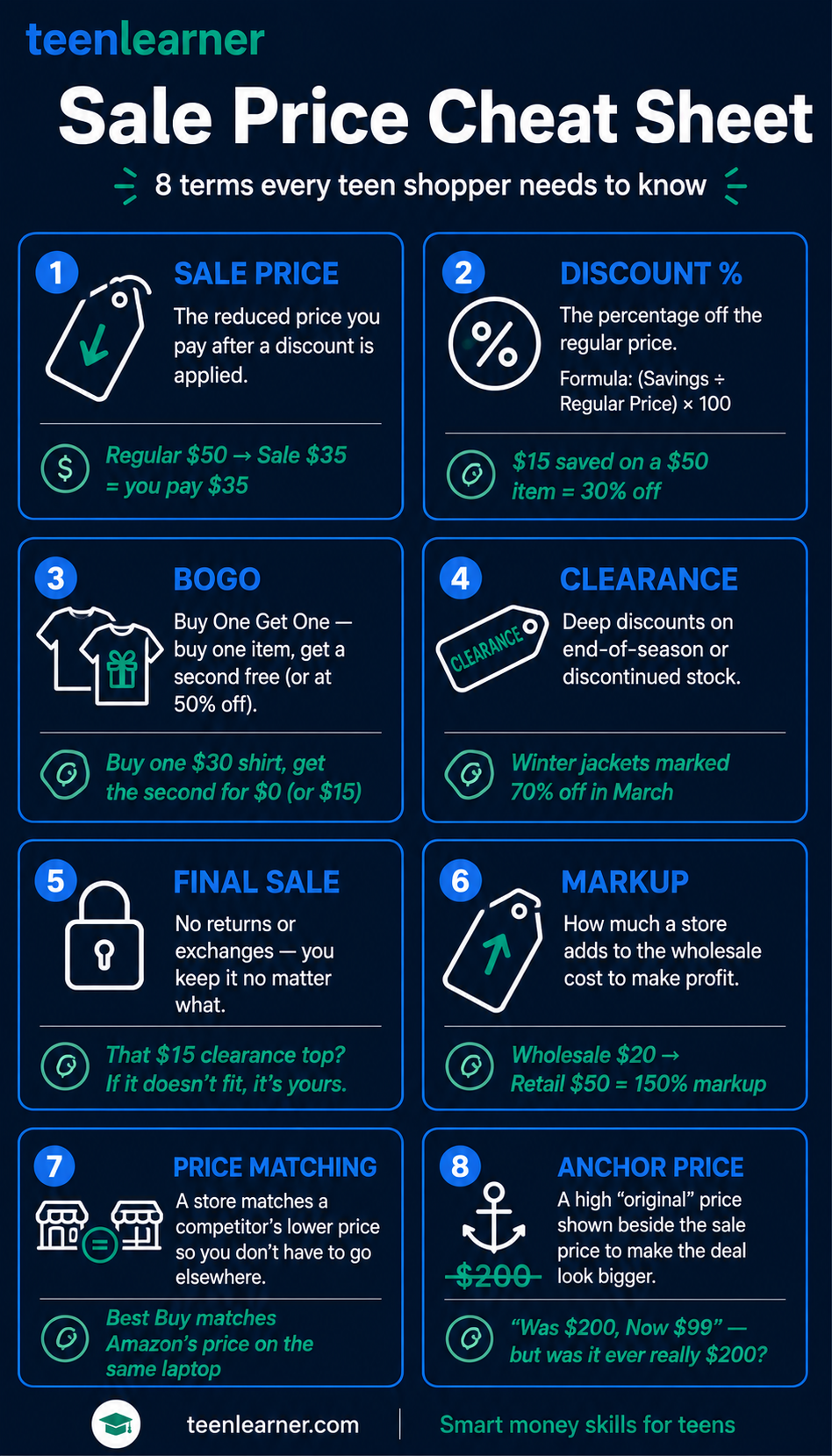
A sale price is the reduced price of an item after a discount has been applied. If a jacket normally costs $80 and it is 25% off, the sale price is $60. Simple enough. But retail stores use a lot more than just “25% off” to get you to spend money, and most teens have no idea what half the terms mean.
The key discount shopping terms every teen should know are: sale price, markdown, clearance, final sale, BOGO, markup, flash sale, price matching, and student discount. Understanding each one helps you spot real deals, avoid retailer tricks, and keep more money in your pocket.
This guide covers how to calculate any sale price in seconds, what every discount label actually means, and how to tell whether a deal is genuinely good or just made to look that way. For more on managing what you spend and save, check out our guide on how to budget for teens.
What Is a Sale Price? (The Simple Answer)
A sale price is the price you actually pay for an item after a discount has been subtracted from its regular price. The regular price is also called the original price or the retail price. The sale price is the lower, temporary version that applies during a promotion.
For example: if a pair of headphones has a regular price of $120 and they are 25% off, the sale price is $90. You save $30.
The term “sale price” is different from “selling price.” The selling price is what a store normally charges day-to-day. The sale price is the discounted version that applies during a limited promotion. When the sale ends, the item returns to its selling price.
Sale prices can come from many types of promotions: a percentage-off weekend event, a seasonal clearance, a BOGO deal, or a coupon code. The label looks different in each case, but they all produce a sale price that is lower than the original.
How to Calculate a Sale Price: The Formula Every Shopper Needs
The sale price formula is: Sale Price = Original Price x (1 – Discount %). To use it, convert the discount percentage to a decimal, subtract it from 1, then multiply by the original price.
Example: 40% off a $65 item
- 40% as a decimal = 0.40
- 1 – 0.40 = 0.60
- $65 x 0.60 = $39.00 (your sale price)
- Savings: $65 – $39 = $26.00
Shortcuts for common discounts:
- 10% off: multiply the original price by 0.90
- 20% off: multiply by 0.80
- 25% off: multiply by 0.75
- 50% off: divide by 2
You can also reverse the formula. If something is $42 on sale and the tag says it was $60, the discount percentage is: ($60 – $42) / $60 = 0.30, which is 30% off. Knowing this means you can verify the math on any sale tag in a few seconds rather than trusting what the retailer puts on the sticker.
Sale vs. Clearance vs. Final Sale: What Is the Difference?
Sale, clearance, and final sale are three different types of price reductions with very different meanings for the shopper. The biggest mistake teens make is treating all three the same way.
Sale is a temporary price reduction. The item will return to its regular price when the promotion ends. “20% off this weekend only” is a typical sale. If you miss it, the item will go back up in price, but it will likely go on sale again.
Clearance is a deeper, usually permanent price reduction on items the store wants to clear out. Clearance happens when a product is being discontinued, a new season is starting, or stock needs to make room for incoming inventory. Clearance discounts are almost always larger than regular sale discounts, and once clearance stock sells out, it is gone for good.
Final sale is a clearance or sale item with a strict no-returns policy attached. When something is labelled “final sale,” the store will not accept it back, even if it does not fit or you change your mind. This is not always displayed clearly, especially when shopping online. Look for it in the fine print at checkout.
A simple rule: if it says “final sale,” be 100% sure you want it before paying. You will not be able to return it.
BOGO, Flash Sales, and Other Discount Types Explained
Beyond basic percentage-off deals, retailers use several other discount formats. Here is what each one actually means so you are not caught off guard at the checkout.
BOGO (Buy One, Get One): You buy one item and get a second at a reduced price. “BOGO 50% off” means the second item is half price. “BOGO free” means the second item costs nothing. The catch: BOGO only makes sense if you genuinely want two of the item. Buying something you do not need just to get the second one “free” means you spent more, not less.
Flash Sale: A flash sale is a very short discount window, often 24 hours or less. The urgency is intentional and designed to make you skip comparison shopping. Before buying during a flash sale, take 60 seconds to check the price at one other store. Many “flash” prices are identical to prices available elsewhere every day.
Doorbusters: Doorbusters are steep discounts on a small number of items, designed to get shoppers into the store. You see these most often on Black Friday. The $199 TV doorbuster might only have 10 units available. If you miss it, everything else in the store is regular price.
Bundle Deals: A bundle is when multiple items are sold together at a combined discount. Bundles save money only if you need everything in the package. A $50 bundle of a phone case, screen protector, and charger might be a great deal, or it might mean paying for two things you already own just to get the one thing you wanted.
Coupon and Promo Codes: Codes entered at checkout to reduce the total. Many online stores allow stacking a coupon code on top of an existing sale price. Browser extensions like Honey and Capital One Shopping automatically test available promo codes when you are checking out online, which can add extra savings with no effort.
Markup vs. Markdown: Why Stores Discount in the First Place
Understanding markup and markdown helps you see discounts from the store’s perspective, which makes you a sharper shopper.
Markup is the amount a store adds to the wholesale (cost) price to arrive at the retail price. A t-shirt that costs the retailer $10 to buy wholesale might retail for $35. That is a $25 markup, or roughly 250% above wholesale cost. Most retail clothing markup runs between 100% and 300% above what the store paid, which means there is significant room to discount before a store loses money.
Markdown is the reduction from the retail price. A 30% markdown on that same $35 t-shirt brings it to $24.50. The store paid $10 for it, so it still makes a profit of $14.50.
This matters because most regular sales are still profitable for the retailer. A “40% off” weekend event rarely means the store is losing money. Deep clearance near the end of a season, however, is where retailers genuinely approach break-even and where the real value for buyers exists. The best time to buy seasonal clothing, holiday decorations, or outdoor gear is right after the season ends, not when the season begins.
Understanding markup and markdown also helps you budget better overall. If you want a stronger system for tracking what you spend on clothing and shopping, our guide on how much money a teenager should save walks through setting realistic targets by spending category.
Price Matching: The Easiest Way to Save Without Waiting for a Sale
Price matching means a retailer agrees to sell you an item at a competitor’s lower price for the same product. You find it cheaper somewhere else, show the store proof, and they match it on the spot. Most teens have no idea this is an option.
Major retailers that commonly offer price matching include Best Buy, Walmart, Canadian Tire, Target, and Home Depot. Policies vary, so it is worth checking the store’s website before you shop.
How to use price matching in four steps:
- Find the item at Store A.
- Search the exact same product (same model, same specs) at Store B and find a lower price.
- At checkout, show Store A proof of the lower price, either a screenshot or the competitor’s app open on your phone.
- Ask for the price match. In most cases, they will match it immediately.
Some stores also price match their own website versus their in-store price, which means you can often save just by pulling up the retailer’s online listing while standing in the store. Price matching is most useful for electronics, appliances, and sporting equipment, where the same product is sold at multiple retailers at the same time. It works less reliably for clothing and brand-exclusive items.
Student Discounts: Money Teens Are Leaving on the Table
Student discounts are price reductions available exclusively to students, typically verified through a school email address or a student ID. They are one of the most underused money-saving tools available to teens, and most of them require nothing more than a free sign-up.
The two biggest student discount platforms:
Student Beans and UNIDAYS are both free to join. You verify your student status with a school email address and get access to discounts from hundreds of brands, including Nike, Apple, Spotify, ASOS, and Microsoft. There is no cost to use either platform.
Student discounts worth knowing about right now:
- Apple Education Pricing: Up to $200 off MacBooks and iPads for students and educators
- Spotify Student: Roughly 50% off a Premium subscription
- Adobe Creative Cloud: Up to 65% off for students and teachers
- Amazon Prime Student: A 6-month free trial followed by a discounted annual rate
- Clothing brands: Many offer 10 to 15% off through UNIDAYS or Student Beans
Before buying anything online, search “[brand name] student discount” or check the brand’s website for a Students or Education section. A school email address is usually all you need. It takes about 30 seconds to verify, and the savings across a full year of purchases can be significant. For more ways to cut what you spend day-to-day, our list of 10 money saving tips for teens covers practical habits that build up quickly.
Retailer Pricing Tricks (and How to Tell If a Deal Is Actually Real)
Not every sale is a real deal. Retailers use several proven psychological pricing tactics to make products seem like better value than they are. Knowing these tactics means you will not fall for them.
Inflated original prices: Some retailers raise the listed “original” price before putting an item on sale, so the discount looks larger than it is. A jacket that costs $80 gets relabelled as $160 and then put “on sale” for $80, the same price it always was. This is common in outlet stores and on some online marketplaces. The percentage off is real; the original price was invented.
Charm pricing: $29.99 feels meaningfully cheaper than $30 even though the difference is one cent. Our brains read left to right and register the “29” before the “99,” so we round down instinctively. Retailers have used this for over 100 years because it works. When you see .99 pricing, round up to the nearest dollar in your head.
Price anchoring: You see a $500 TV sitting beside an $800 TV. The $500 TV looks like a deal, because the $800 one serves as an “anchor” that makes everything else feel cheap by comparison. The store placed the high-priced item there on purpose. Judge each product on its own value, not what it is sitting next to.
Artificial urgency: “Only 3 left in stock!” and “Sale ends in 2 hours!” are designed to push you to buy before you have time to compare prices. Sometimes these are genuine. Often they are not. If you see a countdown timer on a website, open the same page in a new browser tab, and many timers simply reset.
How to verify a deal is actually real:
- Google Shopping: Search the item name and see what other stores are currently charging for the same product.
- Honey / Capital One Shopping: These free browser extensions track price history and automatically apply coupon codes. If a product has been “on sale” for 90 days straight, it is not a sale.
- CamelCamelCamel: For Amazon purchases, this free tool shows the full price history of any product. If the current “sale price” is not actually the lowest the item has been, you can see it immediately.
The best deals on clothing and seasonal items usually appear at the end of a season, not the start of a sale event. Retailers begin seasonal clearance early, but the deepest discounts come in the final days of a clearance cycle when they need to move remaining stock. Patience is one of the most effective discount strategies there is. If you are saving up for something specific, our guide to buying your first car as a teenager shows how to apply the same kind of planned, research-first approach to a major purchase.
Keep learning: needs vs wants and loans for teens.
Frequently Asked Questions (FAQ)
What is the difference between a sale price and a regular price?
The regular price (also called the original or retail price) is what a store normally charges for an item day-to-day. The sale price is a temporary reduced price applied during a promotion. When the promotion ends, the item returns to its regular price.
How do you calculate a sale price?
To calculate a sale price, use: Sale Price = Original Price x (1 – Discount %). For example, a $50 item at 30% off: $50 x (1 – 0.30) = $50 x 0.70 = $35. Your sale price is $35 and you save $15.
What does final sale mean?
Final sale means the item cannot be returned or exchanged after purchase, regardless of the reason. It is a permanent sale with a no-returns policy attached. Always check the return policy before buying final sale items, especially online where you cannot try things on first.
What is BOGO and is it actually a good deal?
BOGO stands for “Buy One, Get One” and it means you receive a second item at a reduced price or free when you buy the first. BOGO is a good deal only if you genuinely want two of the item. If you buy a product you do not need just to get the second one free, you have spent more money, not less.
If you found this article useful, join the TeenLearner newsletter for more practical guides on earning money, building skills, and managing your finances as a teenager. New articles go out every week, written specifically for teens who want to get ahead before they graduate.