

You have probably typed some version of this into Google. Online business for a 14 year old. Online business for students. Something you can run from your phone between homework and practice. Most lists skip the part that matters most, which is what you are actually allowed to do at your age.
The best online business ideas for teens and students are UGC creation, affiliate marketing with short videos, social media management, influencing, YouTube, print on demand, blogging, handmade goods, digital products, online tutoring, AI-assisted design, AI automation, freelance writing, video editing, web design, reselling, and building apps. Which ones fit you depends on your age, because platforms set their own minimums and most payment tools expect an adult account holder.
This guide sorts the 17 ideas by age, shows what each one costs and what to expect in your first month, and explains the platform rules that trip up under-18s. Most pay little or nothing at first, and the teens who stick with one for 90 days are the ones who see results. When you are ready to launch, our guide on how to launch your online business step by step picks up where this one ends.
Which Online Business Ideas Fit Your Age?
Ideas that need no account, or a parent-owned account, suit ages 13 and 14, while ideas involving clients, contracts or ad payouts become realistic from about 15 or 16 and open up fully at 18. Anyone under 18 should involve a parent in payments and agreements.
Online Business Ideas for 13 and 14 Year Olds
Build a skill and an audience while a parent handles any money. Good fits are a YouTube channel (idea 5), a blog (7), handmade goods (8) and digital products (9) sold through a shop your parent owns, and tutoring younger students you know (10).
Online Business Ideas for 15 and 16 Year Olds
At 15 and 16 you can work for real clients, as long as a parent reads any agreement and receives payments. Good additions are UGC creation (1), social media management for local businesses (3), print on demand (6), AI-assisted design (11), freelance writing (13), video editing (14) and reselling (16).
Online Business Ideas for 17 and 18 Year Olds
Turning 18 is the biggest jump, because most freelance and ad platforms then let you hold your own account. At 17 and 18 add short-video affiliate marketing (2), influencer partnerships (4), AI automation services (12) and web design (15).
Online Business Ideas for College and University Students
College students can hold their own accounts and often have flexible schedules. The higher-skill ideas pay best here, including web design (15), AI automation services (12), building apps (17), tutoring in specialized subjects (10) and freelance writing in a field you study (13).
What Age Do You Need to Be to Start an Online Business?
You can start building an online business at any age, but most platforms that pay you or let you sell require an adult account holder. Under 18, the usual route is an account owned and managed by a parent or guardian while you do the work.
Rules differ by platform, so read the terms before you sign up. This table shows what the platforms named in this guide say about under-18s.
| Platform | Age rule for under-18s |
|---|---|
| Etsy | Account owners must be 18. Ages 13 to 17 can sell through a shop registered and owned by a parent or guardian. |
| Fiverr | Ages 13 to 17 can only use an account owned and managed by a parent or guardian, and the profile must say so. |
| Upwork | You must be 18 or the age of majority in your country, whichever is older. |
| Preply | Tutors must be at least 18. |
| YouTube ad revenue | Google says AdSense requires you to be 18. Under 18, link your channel to an approved AdSense account owned by a parent or guardian. |
Payment tools follow the same pattern. Most expect account holders to be adults, so a parent’s account, or an Interac e-Transfer from your customer to a bank account you can access, is the usual workaround. Our guide to starting a business as a teenager with no money covers getting paid under 18 in more detail.
17 Online Business Ideas for Teens and Students
Most of these ideas cost nothing to start. The table shows startup cost, a sensible starting age and a realistic first month for each one, and every idea ends with a first step you can take this week.
| # | Idea | Startup cost | Good starting age | Realistic first month |
|---|---|---|---|---|
| 1 | UGC creator | $0 | 15+ | $0 to $150 |
| 2 | Short-form video affiliate marketing | $0 | 16+ (program rules vary) | $0 to $50 |
| 3 | Social media manager for small businesses | $0 | 16+ | $0 to $300 |
| 4 | Social media influencer | $0 | 16+ | $0 |
| 5 | YouTube channel | $0 | 13+ | $0 |
| 6 | Print on demand | $0 to $20 | 15+ with a parent-owned shop | $0 to $50 |
| 7 | Blogging and affiliate marketing | $0 | 13+ | $0 |
| 8 | Handmade goods | $10 to $50 | 13+ with a parent-owned shop | $0 to $100 |
| 9 | Digital products | $0 | 13+ with a parent-owned shop | $0 to $50 |
| 10 | Online tutoring | $0 | 14+ | $50 to $250 |
| 11 | AI-assisted design services | $0 | 15+ | $0 to $150 |
| 12 | AI automation services | $0 to $20 | 17+ | $0 to $300 |
| 13 | Freelance writing | $0 | 16+ | $0 to $100 |
| 14 | Video editing | $0 | 14+ | $0 to $200 |
| 15 | Web design | $0 to $20 | 16+ | $0 to $300 |
| 16 | Reselling | $0 to $50 | 15+ with a parent account | $20 to $150 |
| 17 | App, game or Chrome extension | $0 to $50 | 15+ | $0 |
Starting ages are planning suggestions, not platform rules, and first-month figures are rough estimates for a few hours a week.
1. UGC Creator
UGC stands for user-generated content, which means short videos and photos of products that brands use in their own ads. Brands want natural-looking content, so good lighting and honest reactions matter more than your follower count. A parent should read any agreement and receive the payment. Your first step is to film three sample videos of products you already own and send them to five small brands.
2. Short-Form Video Affiliate Marketing
Affiliate marketing means earning a commission when someone buys through your link, and short videos on TikTok, Instagram Reels or YouTube Shorts are the usual way to share those links. Each affiliate program sets its own age rules and some require you to be 18, so read them before you apply. Your first step is to post ten videos about products you really use before you apply anywhere.
3. Social Media Manager for Small Businesses
Local shops, gyms and salons often want steady Instagram or Facebook posts but do not have the time. You plan, create and schedule the posts for a monthly fee. Your first step is to make three sample posts for a business you know and show them to the owner, with a parent aware of the conversation.
4. Social Media Influencer
Brands pay influencers for posts that reach a loyal audience, and audiences take months to build. Treat this as a slow build around one clear topic, and bring in a parent for any sponsored deal. Your first step is to choose one niche and post at the same time each week for 90 days.
5. YouTube Channel
YouTube pays through ads and sponsorships once a channel qualifies. Ad revenue needs an approved AdSense account, and Google says AdSense requires you to be 18, so teens under 18 link their channel to an approved account owned by a parent or guardian. Your first step is to pick one topic and publish four videos before you check the numbers.
6. Print on Demand
Print on demand means a company prints and ships your design on shirts, mugs or phone cases only when someone orders. Services such as Printful and Printify handle the printing and shipping, and you sell through a storefront such as Etsy. Because an Etsy shop must be registered by an adult, a parent opens it for you. Your first step is to make one design in Canva and list it in that shop.
7. Blogging and Affiliate Marketing
A blog can earn through ads, affiliate links and sponsorships, but search traffic often takes many months to arrive. It suits teens who like writing about something they know well, such as gaming or study skills, and free blogging platforms let you start at no cost. Your first step is to write five useful posts on one topic before you promote anything.
8. Sell Handmade Goods
Jewellery, candles, stickers, art prints and knitted items sell well online when the photos are good and the niche is clear. Etsy is the usual marketplace, and under 18 you sell through a shop registered by a parent or guardian. Materials cost about $10 to $50 to begin. Your first step is to make three items, photograph them in natural light and offer them to people you know first.
9. Sell Digital Products
Study guides, planner templates, printables and Canva templates are made once and sold many times. Pick a problem you have already solved for yourself, such as organizing a school week. Selling on Etsy again needs a parent-owned shop. Your first step is to create one product and give it to five classmates for honest feedback.
10. Online Tutoring
Tutoring is one of the fastest ways to earn because you already have the skill. High school tutors often charge $20 to $40 an hour, and more for math and science. Tutoring marketplaces such as Preply require tutors to be at least 18, so under 18 the best route is younger students you know, school notice boards and community groups. Your first step is to ask three teachers or families whether they know a student who needs help, and keep sessions somewhere a parent knows about.
11. AI-Assisted Design Services
AI image tools and Canva let you make posters, logos and social media graphics quickly. Small businesses, school clubs and sports teams often need these and cannot afford an agency. Read each tool’s terms on commercial use and tell clients when you used AI. Your first step is to design five sample posters for a club or team and use them as your portfolio. For more ways to earn with these tools, see our guide on making money with AI as a teen.
12. AI Automation Services
Automation services connect tools such as ChatGPT, Zapier or Make so repetitive jobs run on their own, like sending replies to common customer emails. It is a stretch before 17, because you handle a business owner’s systems and customer information, so it suits 17 and older and college students. Your first step is to automate one task in your own life, then offer the same setup to one small business you know.
13. Freelance Writing
Freelance writers create blog posts, newsletters and product descriptions for businesses. AI tools can help you outline and edit, but clients still expect accurate, original writing. Upwork requires users to be at least 18, so under 18 look for clients directly, such as local businesses and school or club newsletters. Your first step is to write three sample articles on topics you know and pitch five local businesses. A starting price of $25 to $75 for a short blog post is realistic while you build samples.
14. Video Editing
YouTubers, small businesses and sports teams all need edited video, and CapCut and DaVinci Resolve both have free versions that are enough to begin. Start by editing for friends and small channels, then move to paid clients. Your first step is to turn a friend’s raw clip into a 30-second highlight reel and post it as your first sample.
15. Web Design
Many small businesses have an outdated website or none at all. Free builders such as WordPress.com and Google Sites let you make a simple site without writing code. Your first step is to build a free one-page site for someone you know, such as a music teacher or coach, and use it as your portfolio.
16. Reselling
Reselling means selling items for more than you paid, or selling things you already own. Start with items at home to learn photos, pricing and shipping. Marketplace apps usually expect adult account holders, so list under a parent’s account and meet buyers in public places with a parent present. Your first step is to sell five items you no longer use and track exactly what you earn.
17. Create an App, Game or Chrome Extension
Building an app, game or browser extension takes real skill, and most first projects earn little or nothing. It works best as a portfolio project that proves what you can do. No-code tools such as Bubble let you build without full programming, though publishing on app stores usually involves a developer fee, so check current costs first. Your first step is to build a tiny tool that solves one problem you have.
How Do You Pick the Right Online Business?
Pick the idea that matches a skill you already have and that your age lets you start this month, then commit to it for 90 days. Trying five ideas at once usually leads to five half-finished projects.
The flowchart below sorts the ideas by what you like doing. The earning ranges in it show what established sellers charge, not what to expect in your first month.
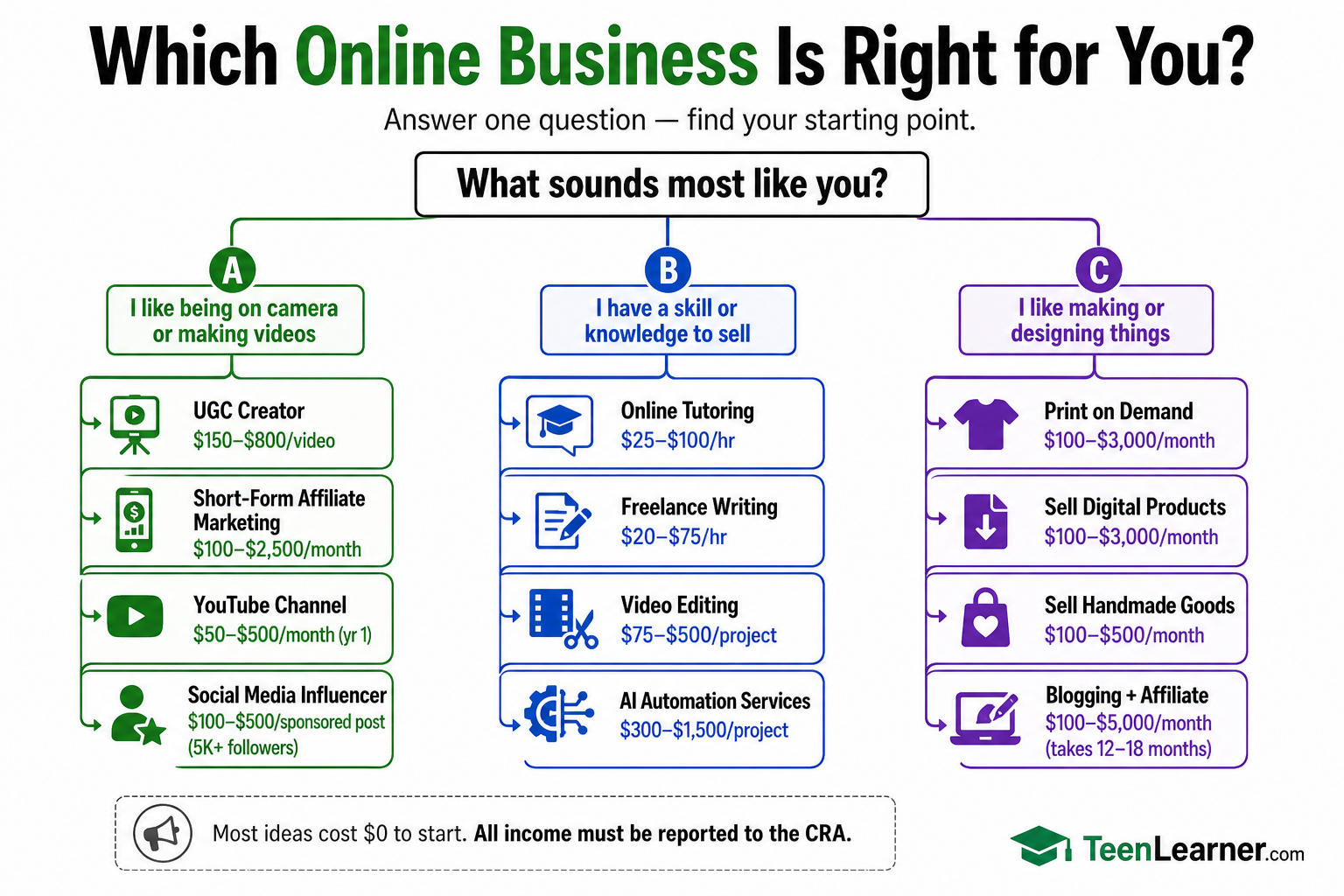
If you are not sure an idea will sell, test your business idea before you build it with ten short conversations. For in-person ideas such as lawn care or babysitting, see our list of small business ideas for teens, and for the wider picture of ways to earn, read our guide to earning money online as a student.
As AI tools improve, work built on your own judgment and relationships, such as tutoring, local social media management and original writing, tends to hold up better than tasks a tool can do in seconds.
Do Teens Pay Tax on Online Business Income in Canada?
Yes. Business income is taxable in Canada at any age, and you report it on your tax return even if you owe nothing. Most teens with a small side income owe no federal tax as long as their total income for the year stays under the federal basic personal amount, which is roughly $16,000 a year.
Keep a record of what you earn and spend, and see our guide to taxes on teenage income for what to file.
Frequently Asked Questions (FAQ)
Do I need to be 18 to start an online business?
No, but many platforms require account holders to be 18. Under 18, most teens use an account owned and managed by a parent or guardian, which is what Etsy and Fiverr require for ages 13 to 17. You can still do the work, build a portfolio and find your own clients.
What online business can a 14-year-old start?
A 14-year-old can start tutoring younger students, a YouTube channel, a blog, video editing for small channels, or handmade goods and digital products sold through a parent-owned shop. Keep payments and agreements with a parent, and choose the idea that matches a skill you already have.
How much can a teen make in the first month?
Most teens earn between nothing and about $250 in the first month while they build samples and find a first customer. Tutoring and local services usually pay soonest. YouTube, blogging and influencing typically take many months. Treat the first 90 days as practice.
What is the easiest online business for a student to start?
Online tutoring, video editing and social media management for a local business are the easiest starting points. You sell a skill you already have, you need no upfront money, and your first customer can come from people you already know.
First-month figures and prices in this article are rough planning estimates, not guarantees. Platform rules change, so check each platform’s current terms before you sign up. This article is educational and is not financial or legal advice.
If you found this article useful, join the TeenLearner newsletter for more practical guides on earning money, building skills, and managing your finances as a teenager. New articles go out every week, written specifically for teens who want to get ahead before they graduate.