

How to Create a Money Saving Plan for Students (2026 Guide)
A money saving plan for students works best when it is built around your real income, not an ideal version of it. This guide walks through six steps: tracking what you actually earn, setting a specific goal, choosing a saving method that fits student life, opening the right account, automating your savings, and adjusting the plan when your income shifts. By the end, you will have a flexible system you can start today with whatever you have right now.
Key Insights
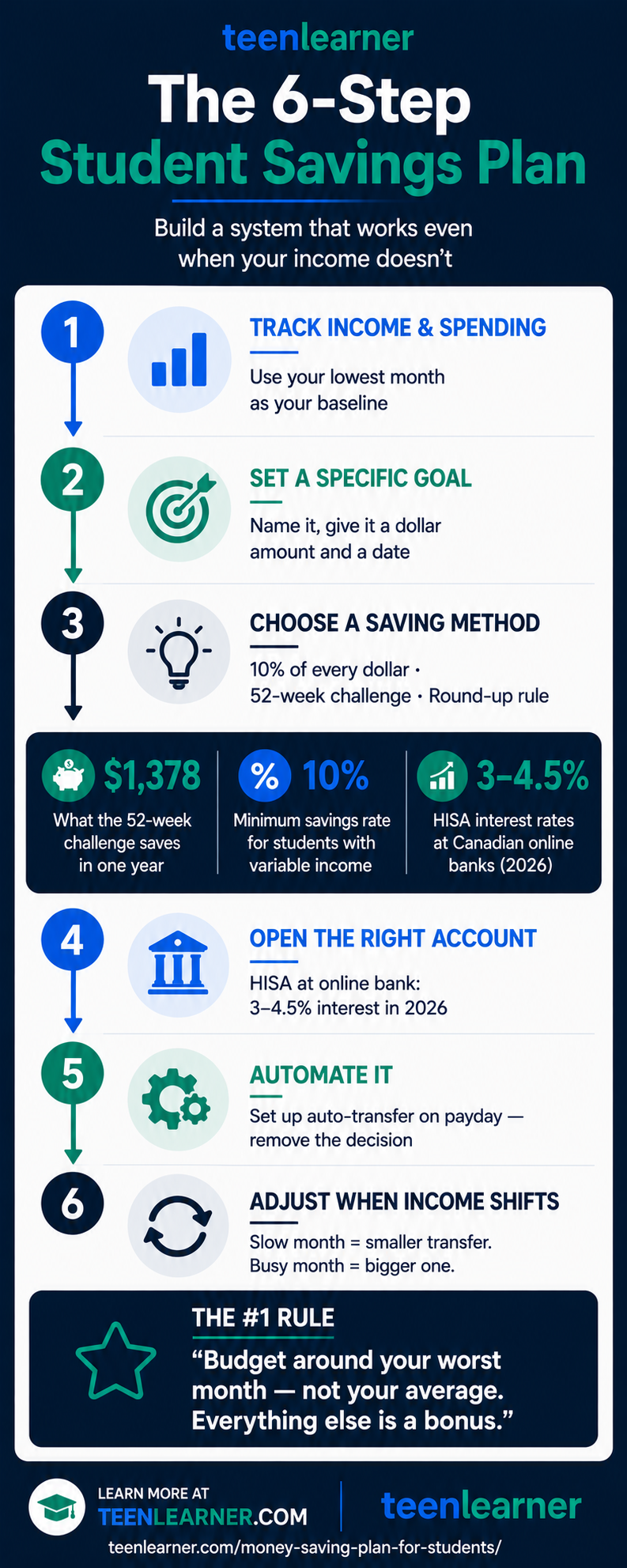
- Most student saving plans fail because they are built on income averages instead of income minimums. Budget around your worst month and treat everything else as a bonus.
- Saving 10 percent of every dollar you earn is a strong starting point. If that feels impossible, start at 5 percent and increase it by 1 percent each month.
- The 52-week savings challenge is one of the easiest ways for students to save over $1,300 in a year with very little effort at the start.
- In Canada, high-interest savings accounts (HISAs) at online banks are paying 3 to 4.5 percent annually in 2026, significantly more than standard chequing accounts.
- Automating your savings the moment you get paid removes the decision entirely, and that is why it works when willpower does not.
Why Students Struggle to Save Money
Students struggle to save money primarily because most saving advice is designed for adults with stable monthly paycheques, and student income does not work that way. You might work full shifts in October, take time off for exams in November, and pick up extra hours again in December.
Tips like “save 20 percent of your income” assume you have the same income every month, predictable expenses, and money that arrives on a set schedule. When income swings by hundreds of dollars from week to week, a fixed-dollar savings plan breaks at the first slow month.
What students actually need is a plan built on a fixed percentage, not a fixed dollar amount. That way, your savings automatically adjust when your income does. A slow month means a smaller transfer. A busy month means a bigger one. The plan keeps working no matter what. If you are still working out the basics of managing income, our guide on budgeting for teens covers where to start.
Step 1: Know Exactly What You Earn and Spend
You cannot build a money saving plan until you know your actual numbers. Spend two weeks writing down every dollar that comes in: part-time job pay, cash from parents, birthday gifts, side hustle income, and anything else. Do not estimate. Look at your actual bank statements or pay stubs.
Once you have two weeks of data, identify two numbers. First, your average monthly income over the past three months. Second, your minimum reliable month, the lowest amount you earned in any single month. Build your saving plan around that minimum so it holds up even in a slow month.
Track your spending at the same time. Write down everything you buy, including coffee, streaming subscriptions, transit, and late-night food. According to the Consumer Financial Protection Bureau, teens who track spending for even one month consistently identify $30 to $80 in spending they are willing to cut. That awareness alone changes how you spend.
Step 2: Set a Goal That Actually Motivates You
A specific, time-based savings goal is more effective than a vague intention to save more. Saving money with no destination is hard. Saving $400 for a concert you want to attend in August is easy because the goal gives the sacrifice a clear point.
Instead of “I want to save more,” write: “I want $800 in my savings account by July 1st.” Then work backwards. If you have 12 weeks, you need to save about $67 per week. If you earn $200 a week on average, that is 33 percent of your income. If that is too aggressive, either extend your timeline or pick a smaller target.
Running two goals at once works well. A short-term goal (something 1 to 3 months away) gives you quick wins. A long-term goal (something 6 to 12 months away) builds real wealth. Split your savings between two accounts, one for each goal, to keep the money separate. For more on building realistic saving targets as a teenager, that article covers specific benchmarks by age.
Step 3: Choose a Saving Method That Fits Your Life
There is no single best saving method. The best one is the one you will actually stick to. Four approaches work well for students with irregular income.
The percentage method means saving a fixed percentage of every dollar you earn. Ten percent is the standard starting point. If you earn $180 this week, you put $18 into savings. If you earn $320 next week, you put $32 in. The amount changes but the rule stays constant. This is the most adaptable method for variable income.
The 50/30/20 method divides your income into three buckets: 50 percent for needs (food, transit, phone), 30 percent for wants (entertainment, clothing, eating out), and 20 percent for savings. This works once your income is more predictable. Financial Consumer Agency of Canada’s budgeting tools explains this framework in detail for students just getting started.
The 52-week challenge is a simple escalating plan. In week 1 you save $1, in week 2 you save $2, and so on up to $52 in week 52. You finish the year with $1,378 saved. The value of this method is that it starts so small it removes every excuse for not starting, and by the time the amounts get larger the habit is already formed.
Pay yourself first means transferring your savings the moment your pay hits your account, before you spend anything else. You decide the percentage ahead of time, the transfer happens right away, and then you live on whatever is left. This works because savings become non-negotiable instead of optional.
Step 4: Open the Right Savings Account
A dedicated savings account that is separate from your spending money is the single most important structural decision in your plan. A chequing account is the wrong place for savings because it is too easy to spend. A savings account with a small friction barrier (a different bank, no debit card attached) makes you far less likely to dip into it for impulse purchases.
In Canada, a high-interest savings account (HISA) at an online bank like EQ Bank, Tangerine, or Simplii Financial typically pays significantly more interest than the big bank accounts most students open first. In 2026, the top rates for student-accessible HISAs sit between 3 and 4.5 percent annually. That difference is meaningful when you are building a balance over 12 months.
If you are 18 or older, a Tax-Free Savings Account (TFSA) is the best long-term option. Any interest or growth inside a TFSA is completely tax-free, and you can withdraw at any time without penalty. The annual contribution limit is set by the CRA each year. For a step-by-step look at how this account works, our TFSA guide for teens covers the setup process in plain language.
Step 5: Automate Your Savings So You Never Have to Think About It
Automation is the most effective saving tool available to students because it removes the decision entirely. You do not have to remember to transfer money, think about saving, or resist spending it first. The money moves before you can touch it.
Most Canadian banks let you set up automatic transfers in under five minutes through online banking. Set up a recurring transfer from your chequing account to your savings account, scheduled for the same day you receive your pay. If your income is irregular and you cannot predict when you’ll be paid, transfer the savings amount manually right after each deposit instead.
Round-up features are worth enabling if your bank§s app offers them. Every time you spend $4.60 on a coffee, the app rounds up to $5.00 and moves $0.40 into savings automatically. It adds up to a few hundred dollars over a year with no extra effort on your part.
Step 6: Adjust the Plan When Your Income Changes
Variable income is the biggest threat to any student savings plan, but it does not have to derail yours if you have a clear rule for what to do when things change.
During a low income month, cut your savings transfer but do not skip it entirely. Saving $10 in a slow month is better than saving $0 and breaking the habit. The habit matters more than the amount in the early months.
During a high income month (overtime, a cash gift, or a side hustle windfall), use the 50/50 rule: put half the extra into savings and spend the other half on something you enjoy. This reward system keeps the plan sustainable long-term.
Run a subscription audit every three months. Review every recurring charge on your account and cancel anything you have not used in the past 30 days. Students with smartphones typically have three to five subscriptions they forgot about. Cutting two of them can free up $20 to $40 per month with no change to your income. This connects directly to the money saving habits that have the biggest impact for teens.
Common Mistakes Students Make With Savings Plans
Setting a savings target that is too aggressive is the most common mistake. If saving 20 percent of your income means you cannot afford groceries or transit, you will quit in week two. Start lower than you think you should, build the habit, and then raise the percentage by 1 to 2 percent each month.
Keeping savings in your main chequing account is the second most common problem. When savings and spending money share the same account, the savings disappear. The physical separation of accounts is what makes the plan real and keeps the money actually saved.
Waiting until you earn more money before starting is the third mistake. The habit of saving is worth more than the amount you save in the early stages. Students who start saving $5 a week at 16 are in a completely different financial position at 25 than students who planned to start once things settled down.
Not reviewing the plan every few months lets it drift. Your income will change, your goals will shift, and your expenses will move. Set a reminder every three months to check what you set up, confirm it is still working, and adjust anything that is off.
Frequently Asked Questions
How much of my income should I save as a student?
Save 10 percent of everything you earn as a starting target. If your income is very low, start at 5 percent and raise it by 1 percent every month until you reach 10 to 15 percent. Consistency matters more than the exact amount in the early months.
What is the 52-week savings challenge?
The 52-week savings challenge is a year-long plan where you increase your weekly savings by $1 each week: $1 in week 1, $2 in week 2, up to $52 in week 52. By the end of the year you have saved $1,378. It works because the small start removes the barrier to beginning, and by the time the amounts get larger the habit is already built.
Should I save in a TFSA as a student?
Yes, if you are 18 or older, a TFSA is the best account to hold your savings in Canada. Your money grows tax-free and you can withdraw at any time without penalty. The sooner you open one, the more contribution room accumulates over your lifetime. A HISA inside a TFSA at an online bank gives you both a competitive interest rate and tax-free growth.
What if my income changes month to month?
Use a percentage method instead of a fixed dollar amount. Decide on a savings percentage (start with 10 percent) and apply it to every dollar you earn regardless of the total. In a month where you earn $100, you save $10. In a month where you earn $400, you save $40. The plan adapts to your income automatically, which means a slow month does not break it.
Last updated: May 2026
Robert Puharich is the founder of TeenLearner, where he helps teens build real-world skills in money, AI, and life. With over 20 years in education and a Master of Education (M.Ed.) from UBC, he created TeenLearner to teach practical skills such as budgeting, career readiness, decision-making, and the wise use of technology. Robert is also a published author and business founder.






Pingback: How to Budget for Teens | 5 Tips - Teen Learner
Pingback: Reasonable Clothing Budget for a Teenager - Teen Learner
Pingback: What are the Benefits of TFSA vs RRSP? - Teen Learner
Pingback: How to Set STAR Goals - Teen Learner