

Needs vs Wants: How to Know If You Actually Need Something
Most teens know food is a need and a concert ticket is a want. The part that trips people up is everything in between. Is the phone upgrade a need when your current one still works? Is eating out a need when you are exhausted and there is nothing at home? Is the gym membership a need if your mental health noticeably improves when you go?
The line between needs and wants is rarely obvious, and that is exactly where most teenagers overspend without realizing it. A need is something you cannot function, stay safe, or meet your basic responsibilities without. Everything else is a want. This article gives you a 5-question test to sort any purchase, a breakdown of the gray areas teens most often get wrong, and a way to connect this thinking to a real budget so your money actually grows over time.
What Is the Difference Between a Need and a Want?
A need is something required for you to survive, stay healthy, or meet a basic obligation like school, work, or safety. Food, shelter, weather-appropriate clothing, transportation to school or work, and basic medical care all qualify. Without these things, your physical wellbeing or ability to function is at real risk.
A want is something that improves your life or makes it more enjoyable, but is not required for you to function. Upgraded technology, name-brand clothes, entertainment subscriptions, eating out, and most things you would describe as “nice to have” fall here. The intensity of how much you want something has no bearing on whether it qualifies as a need.
The most useful way to think about it: needs are about function, wants are about preference. You need a phone to stay in contact with your family and get around your city. You want the newest model with the best camera. Both can be valid purchases, but they belong in different parts of your budget and carry very different levels of priority.
The 5-Question Test: Is This Actually a Need?
Before any purchase you are not sure about, run through these five questions. The test works best when you answer out loud or write the answers down, not just in your head. Keeping it in your head makes it too easy to rationalize whatever you already want to do.
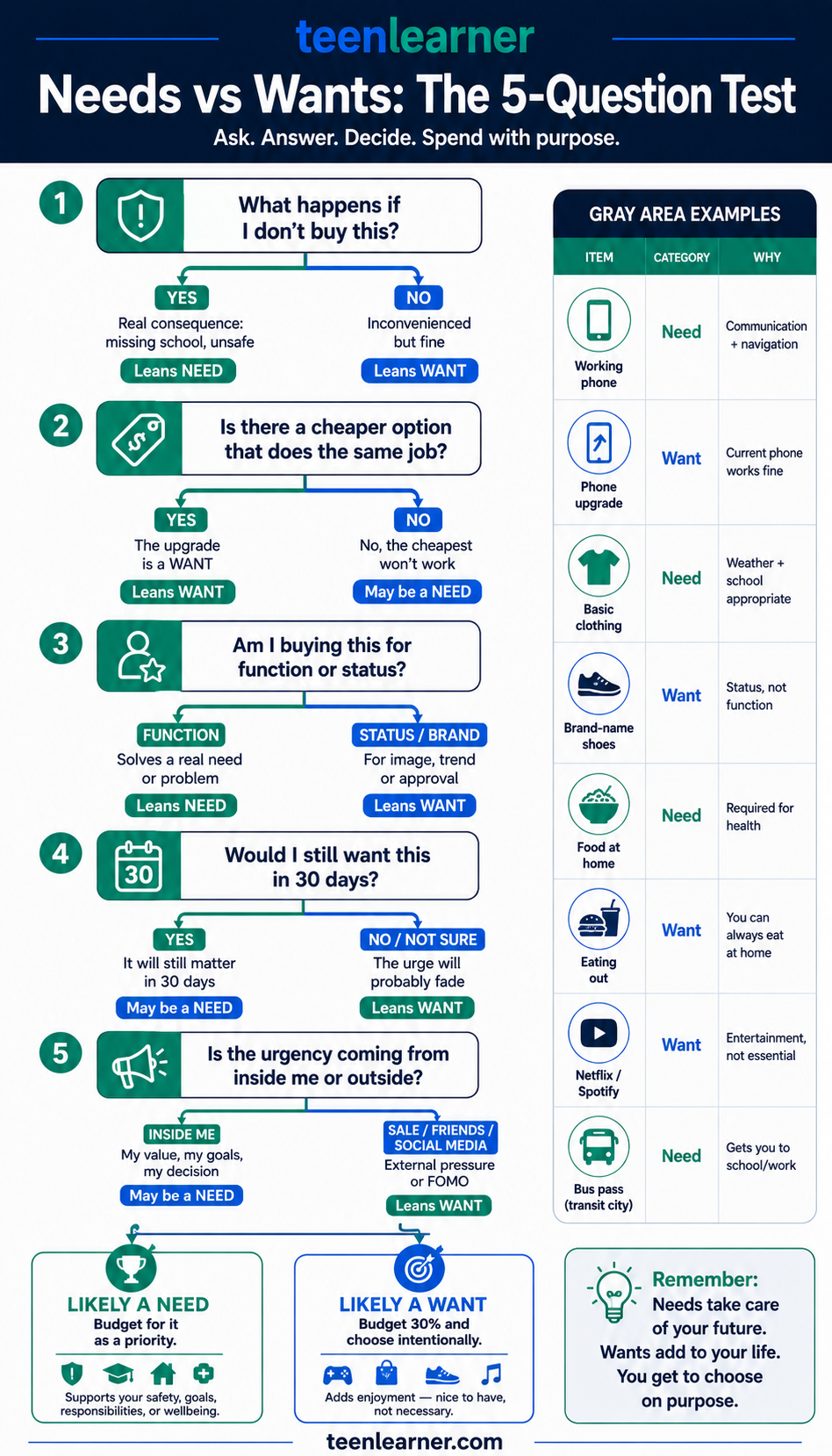
1. What happens if I do not buy this? If the answer is nothing serious, or I will be inconvenienced but fine, it is a want. If the answer involves a real consequence like missing school, going without food, or being unsafe, you are likely looking at a need.
2. Is there a cheaper option that does the same job? If a bus pass gets you where you need to go, a car in that city is a want. If a $250 phone handles everything you need, the $1,100 version is a want even if you do need a phone. The category can be a need while the specific item you are eyeing is still a want.
3. Am I buying this for function or for status? Buying something because it works for you is a need-adjacent decision. Buying it because of the brand name, how it looks to others, or how it makes you feel socially is almost always a want. There is nothing wrong with wants, but name them correctly.
4. Would I still want this in 30 days? Needs do not expire. If you actually need something, you will still need it next month. Wants often fade quickly. The urgency you feel right now is usually a signal you are dealing with a want, not a need.
5. Is the urgency coming from me or from outside? If you feel pressure to buy now because of a sale, because friends have it, or because you saw it online, that urgency is manufactured. Real needs do not require a countdown timer or peer validation. When the pressure is external, the purchase is almost always a want.
Common Gray Areas for Teens: Phones, Clothes, and Eating Out
Most disagreements about needs vs wants happen in the middle, not at the extremes. These are the purchases teens most often miscategorize, and a clearer way to think about each one.
Phone upgrades. A working phone is a need for most teens in 2026: you need it for communication, navigation, and often for school. But upgrading when your current phone works is a want. The question to ask is whether what you have now does what you need it to do. If yes, the new model is a want, regardless of how old the current phone is or how much better the upgrade would be.
Clothing and shoes. Basic clothing is a need. You need to be appropriately dressed for the weather and for school or work. Specific brands, trending styles, or a second pair of the same type of shoe are almost always wants. The rule of thumb: buy to cover the function first, then upgrade to preferences with whatever is left in your wants budget.
Eating out. Food is a need. Restaurants are a want. You can always eat at home or bring food from home for less. Eating out regularly feels like a need because you do have to eat, but you are never actually required to eat there. It is one of the fastest ways teens drain savings without noticing, because each meal feels small and justified in the moment. Budget for it honestly as a want.
Streaming and subscriptions. Entertainment subscriptions are wants. All of them. Netflix, Spotify, gaming subscriptions, app purchases: these improve life, but none of them are required for your health or basic functioning. If you have multiple subscriptions, audit which ones you actually use every week. Cutting one or two frees up real money with very little impact on your daily life.
Transportation. Getting to school or work is a need. The method of transport is where it gets more complicated. A bus pass in a city with reliable transit is a need-level expense. A car in a suburb with no transit, where you actually need it to hold a job, starts to look more like a need. A car in a place where other options exist is a want. Be honest about what you actually require, not just what you prefer.
Why Wants Feel Like Needs: The Social Pressure Problem
The reason needs vs wants is hard for teens specifically is not a lack of information. It is social pressure. When everyone around you has something, your brain starts registering it as normal, expected, and therefore necessary. This is not a personal weakness; it is how human psychology works. Recognizing it is what lets you push back against it.
Marketers understand this and use it deliberately. Ads show people your age using products in social settings where owning the item looks like participation, not just consumption. The implied message is that you are missing out if you do not have it. That feeling of exclusion is real, but buying the thing almost never fixes it. Most social belonging has very little to do with owning specific products.
A practical test: would you still want this item if no one you knew would ever see it or know you had it? If the answer shifts from “yes” to “maybe not,” the desire is primarily social, which makes it a want. That does not mean you cannot buy it. It means you should buy it deliberately, with money set aside for wants, not money earmarked for needs or savings.
How Needs vs Wants Connects to Your Budget
Understanding this distinction is not just a thinking exercise. It directly changes how your money works. The most widely used budgeting framework for teens and young adults is the 50/30/20 rule: 50% of your income goes to needs, 30% to wants, and 20% to savings or debt repayment.
That math only works when you sort your expenses honestly. Teens who misclassify wants as needs end up directing 70% or more of their income to “needs,” leaving very little for savings. The framework falls apart if the categories are not accurate.
Start by listing every regular expense you have and sorting each one honestly into needs or wants. Most teens who do this find their actual needs are lower than they assumed, which means more is available for both intentional wants and savings. For a full step-by-step walkthrough of building a budget around this, read the TeenLearner guide to budgeting for teens.
How to Spend on Wants Without Draining Your Savings
Getting clear on needs vs wants is not about removing everything enjoyable from your life. The 30% for wants in the 50/30/20 rule exists because wants matter. Entertainment, experiences, and things you enjoy are a legitimate part of any real budget. The goal is to spend on them intentionally, not accidentally.
Give your wants category a fixed monthly dollar amount and treat it as a real ceiling, not a rough guideline. When it is gone, it is gone until next month. That creates healthy friction without deprivation. If you have $60 in your wants budget and two things you want to buy, pick the one that matters more. Choosing within your wants budget is a skill that gets easier each time you practice it.
For anything over $50, try the 30-day rule: write it down and wait a month before deciding. Most of the time, the urgency fades on its own. Turns out you did not want it as much as you thought. The purchases that still feel worth it after 30 days are usually the right ones to make.
Teens who consistently spend within their wants budget tend to reach savings goals months ahead of schedule. For specific savings targets by age, read how much a teenager should save each month.
When You and a Parent Disagree on What Counts as a Need
One of the most common places the needs vs wants conversation gets difficult is between teens and parents. You might see something as a need, your parent sees it as a want, and neither side feels like they are being heard.
The most effective approach is to make your case using a function argument rather than an emotional one. Explain specifically what you cannot do without the item, not just how much you want it or that everyone else has it. “I cannot get to my part-time job without reliable transit, and the current route adds 45 minutes each way” is a more persuasive argument than “everyone else gets a ride.” The function argument is testable. The emotional argument is not.
If you are earning your own money, you also have real autonomy over your wants spending. Understanding this framework lets you make that case clearly: your needs are covered, your savings are on track (see savings targets by age), and what you are spending on is coming from a legitimate wants budget. That is a hard argument to push back on.
Frequently Asked Questions
What is the difference between a need and a want?
A need is something required for your health, safety, or ability to function, such as food, shelter, clothing, and transportation to school or work. A want is something that improves your life or enjoyment but is not required for basic functioning. The key test: what specifically cannot happen if you do not have this item?
Is a phone a need or a want for a teenager?
A basic working phone is a need for most teens in 2026 because it is required for communication, navigation, and often for school. However, upgrading when your current phone works is a want. Whether a phone purchase is a need or a want depends on whether the specific item you are buying is required for function or preferred for features and status.
How do you stop confusing wants with needs?
Use the 5-question test before any uncertain purchase: ask what happens if you do not buy it, whether a cheaper option exists, whether you are buying for function or status, whether you would still want it in 30 days, and whether the urgency is coming from inside you or from external pressure. Answering honestly over time rewires how you evaluate purchases.
How do needs vs wants connect to budgeting?
In the 50/30/20 framework, 50% of income goes to needs, 30% to wants, and 20% to savings. The framework only works when you sort your expenses accurately. Teens who misclassify wants as needs end up directing too much toward spending and too little toward savings. Sorting your actual expenses into honest categories is the most important first step in building a budget that works.
Last updated: May 2026
Robert Puharich is the founder of TeenLearner, where he helps teens build real-world skills in money, AI, and life. With over 20 years in education and a Master of Education (M.Ed.) from UBC, he created TeenLearner to teach practical skills such as budgeting, career readiness, decision-making, and the wise use of technology. Robert is also a published author and business founder.