

17 Online Business Ideas for Teens and Students (2026)
Teenagers today have skills the business world values. If you are comfortable making videos, understand social media, or excel at a particular subject, you already have the foundation for an online income. The challenge is knowing where to point that energy.
With Canadian minimum wages ranging from $15.00 to $18.51 per hour depending on your province, and average university tuition sitting at $7,734 per year for domestic undergrads according to Statistics Canada, the financial pressure on students is real. Working part-time at minimum wage during the school year often is not enough to cover tuition on its own, let alone rent, food, and other costs. An online side income can change that picture.
The 17 ideas below can all be started with little to no money, flex around a school schedule, and build into something more valuable the longer you stick with them. None of them are easy, and most take a few months before income becomes consistent. But if you pick one that aligns with something you already enjoy, the learning curve becomes a lot more manageable. For more ways to earn, check out our guide to side hustles for teens.
Key Insights
- Most of these ideas cost nothing to start beyond an internet connection
- Many teens earn $200–$1,000/month working part-time once they find their footing
- Skills like video editing, writing, and design grow in value the longer you practice them
- All income in Canada must be reported on your taxes, including side hustle earnings
How Much Money Does It Cost to Start an Online Business as a Teen?
Almost nothing. As a teen, your two biggest constraints are time and startup capital, and most online businesses on this list are designed to require very little of either. What they do require is consistency. A small effort made daily beats sporadic bursts of motivation every time.
What you actually need to get started: a smartphone or laptop, a reliable internet connection, and a few free accounts (Canva for design, Google Workspace for email and docs), and a payment method your parent or guardian can help set up (PayPal, Stripe, or a bank account with e-transfer). That is it for most ideas here. A few ideas, like web design or app development, do benefit from a laptop over a phone, but even those have free tools to get you started. The skills that matter most, including consistency, curiosity, and the willingness to learn from early mistakes, cost nothing.
Some platforms have age restrictions (usually 18+), which means a parent or guardian may need to help set up accounts or manage payments. This is normal and most platforms make it straightforward with parental co-accounts or oversight.
1. UGC (User-Generated Content) Creator
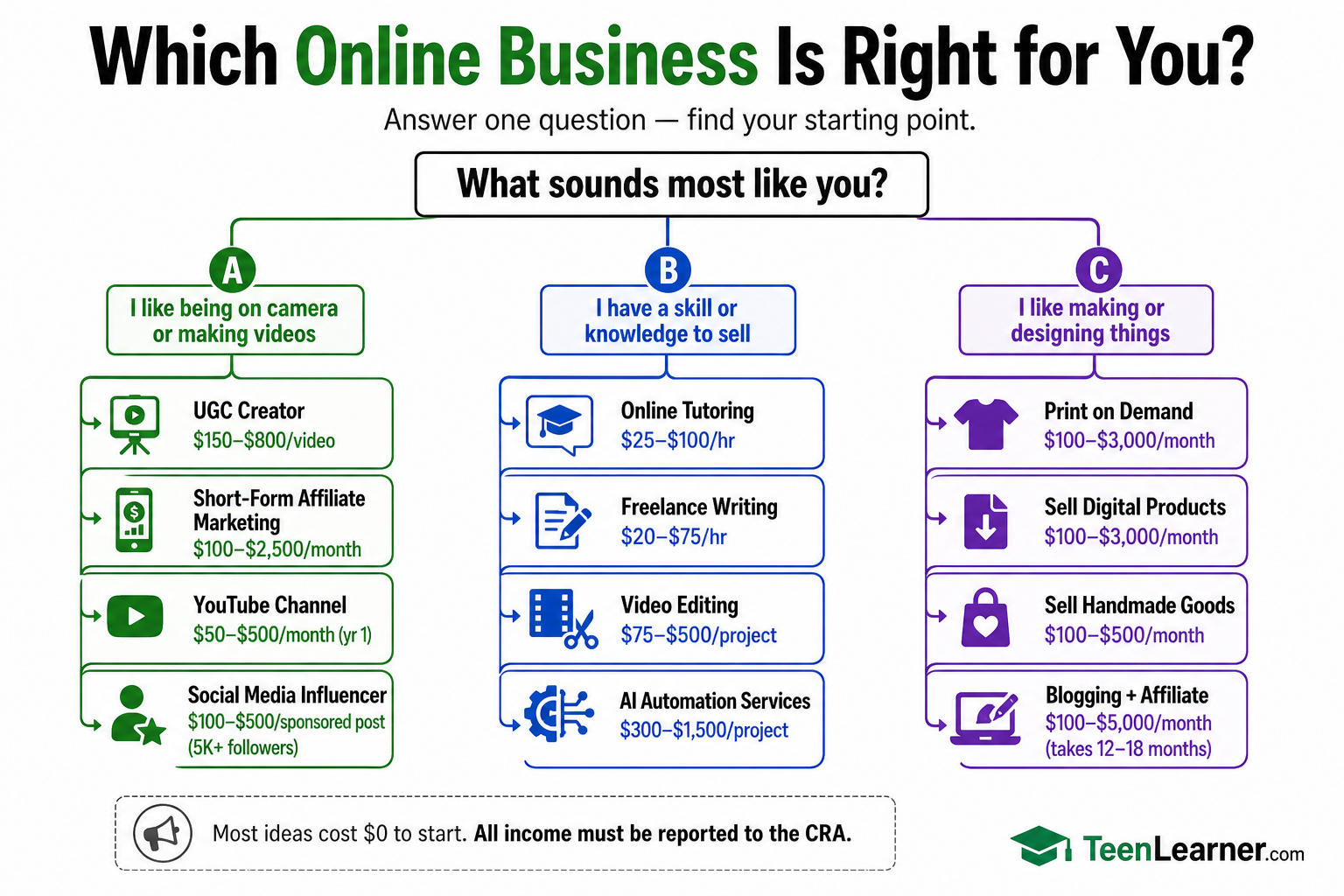
UGC creation involves making authentic product videos and photos that brands use in their advertising. They pay you to create content featuring their products, and they care far less about your follower count than your ability to make something genuine and watchable. Start by creating sample content for products you already own, then reach out to small businesses or join platforms like Insense or Upfluence.
In Canada, beginner UGC creators typically charge $150–$300 CAD per video, with experienced creators earning $400–$800 per deliverable. It is one of the most accessible and in-demand online business ideas for teens right now.
2. Short-Form Video Affiliate Marketing
Affiliate marketing through short-form video involves creating content that features products and earning a commission when viewers purchase through your link. YouTube Shopping Affiliates and brand partnership programs are strong options available to Canadian creators. While TikTok’s dedicated shopping features have limited availability in Canada, TikTok’s creator marketplace allows Canadian creators to connect with brands for paid promotions.
Focus on products your peers actually use (tech accessories, school supplies, affordable fashion) and post consistently. Student affiliates typically earn $100–$500/month starting out, with dedicated creators reaching $1,000–$2,500/month over time.
3. Social Media Manager for Small Businesses
Thousands of local businesses (restaurants, salons, gyms, retail shops) know they need a social media presence but do not have the time or knowledge to run it well. If you already understand how Instagram, TikTok, and Facebook work, that knowledge has real market value. You can offer to create and schedule posts, respond to comments, grow their following, and report on results.
This is one of the best online business ideas for teens in 2026 because you can start with one or two local clients, charge $200–$600/month per account, and scale up as you build a track record. Most student social media managers earn $400–$1,200/month managing two to three clients part-time.
4. Social Media Influencer
As your following grows, brands will want to work with you. Micro-influencers (accounts with between 5,000 and 50,000 followers) typically earn $100–$500 CAD per sponsored post, and engagement rates at this level are often stronger than larger accounts. TikTok and Instagram remain the best platforms for building a following quickly. Find a clear niche, post consistently, and focus on providing real value rather than chasing trends.
5. YouTube Channel
YouTube remains the second-largest search engine in the world. Tutorials, product reviews, study-with-me videos, and niche commentary all perform well when you show up consistently. Most channels need 1,000 subscribers and 4,000 watch hours to qualify for ad revenue, but sponsorships can start earlier. Most student YouTubers earn $50–$500/month in their first year, scaling to $1,000–$5,000+ monthly once they build a real audience.
6. Print on Demand (POD)
Print on demand lets you sell custom-designed products like t-shirts, hoodies, mugs, and phone cases, without holding any inventory. The platform prints and ships for you when an order comes in. Both Printful and Printify are fully available to Canadian sellers with no upfront cost or monthly fees. You only need a basic design and a storefront on Etsy or Shopify to get started. Most student stores earn $100–$500/month in their first year, with successful niche stores reaching $1,000–$3,000/month.
7. Blogging and Affiliate Marketing
Blogging is a long game. It typically takes 12–18 months before Google sends you meaningful traffic. But if you like to write and are actually knowledgeable about a topic (personal finance, gaming, fitness, student life), a blog can become a sustainable income through ads, affiliate commissions, and sponsorships. Student bloggers typically earn $100–$500/month in their second year, with established niche blogs reaching $1,000–$5,000/month. This pairs naturally with learning how to earn money online as a student.
8. Sell Handmade Goods
If you enjoy making things like jewelry, candles, art prints, stickers, or knitted items, Etsy makes it easy to sell them online. Building a presence on Pinterest or Instagram can drive consistent traffic to your store. Most student sellers earn $100–$500/month in their first year, with popular or seasonal products pushing higher during holidays and gift-giving periods.
9. Sell Digital Products
Digital products like templates, fonts, printables, e-books, study guides, and custom portraits can be created once and sold repeatedly with no additional cost per sale. Etsy, Gumroad, and your own website are all solid selling platforms. The time you invest upfront can generate passive sales for months or years. Most students earn $100–$500/month, with premium digital creators reaching $1,000–$3,000/month.
10. Online Tutoring
If you consistently do well in a subject, other students will pay for your help. High school tutors in Canada typically charge $25–$50/hour, while college students teaching specialized subjects like calculus, chemistry, or test prep can earn $60–$100/hour. Find clients through platforms like Preply, or advertise through school networks, community boards, and local Facebook groups. This is one of the most reliable ways to build steady part-time income as a student.
11. AI-Enhanced Creative Services
Rather than competing on basic design alone, combine AI tools like Midjourney, DALL-E, and Canva AI with your creative judgment to deliver strong work at a competitive price. Businesses need logos, social media assets, and branding, and students who can deliver quality quickly have a real advantage. Most students charge $50–$150 per project starting out, with stronger portfolios commanding $200–$500+ for comprehensive packages. Find your first gigs on Fiverr to start building reviews and a client base.
12. AI Automation Services
Small businesses are eager to use AI tools but often do not know where to start. If you understand platforms like ChatGPT, Zapier, Make.com, or Notion AI, you can offer to build simple automations (automated email responses, content workflows, social media scheduling systems) for local businesses and entrepreneurs. This is one of the most in-demand skills of 2026 and one that very few teens are offering yet.
Most student AI automation freelancers charge $300–$800 per project or $500–$1,500/month on a retainer basis. The barrier to entry is low if you are already comfortable with technology, and the earning potential is among the highest on this list.
13. Freelance Writing (AI-Enhanced)
Writers who can use AI tools effectively while maintaining quality, originality, and a distinctive voice are in real demand. Content marketing, newsletters, and specialized industry writing all need people who can research and write well. High school writers typically earn $0.05–$0.10 per word or $20–$35/hour; college students with subject-matter expertise can earn $0.10–$0.25 per word for technical content. Find gigs on Upwork or Writers.work to get started.
14. Video Editing
Video content is essential for brands, YouTubers, and small businesses, and demand for skilled editors keeps growing. Accessible tools like CapCut, DaVinci Resolve (free), or Adobe Premiere make it possible to start building a portfolio without expensive equipment. High school editors typically charge $20–$40/hour or $75–$200 per video. Those with advanced skills can earn $30–$75/hour or $200–$500+ per project. Upwork is a strong platform to land your first clients and build reviews.
15. Web Design
Every business needs a website, and many small businesses have outdated or poorly built ones. Learning WordPress or Webflow gives you a marketable skill relatively quickly, and there is no shortage of local clients. High school web designers typically charge $300–$1,000 per basic site. College students with stronger technical skills can command $1,500–$5,000+ per project. Adding a monthly maintenance package creates reliable recurring income on top of project work.
16. Sell on eCommerce Platforms
Reselling (buying items at a lower price and selling them at a profit) is a legitimate and scalable model. Start by selling unused items from home to learn how the process works, then move into categories you understand well. eBay, Facebook Marketplace, and Poshmark are popular platforms in Canada. Most student sellers earn $200–$1,000/month in their first year, with effective operators reaching $3,000–$10,000/month as they develop sourcing systems and product knowledge.
17. Create an App, Game, or Chrome Extension
This requires real technical skill but carries some of the highest income potential on this list. No-code platforms like Bubble make it possible to build functional apps without traditional coding, though a basic understanding of logic and design still helps significantly. The key is finding an underserved niche or a problem with a clear solution. Most successful apps earn $500–$2,000/month, with top performers earning significantly more, though those results take time and iteration to reach.
What Do Teens Need to Know Before Starting an Online Business?
Starting any online business requires basic legal awareness. Depending on your province, you may need to register your business once you reach a certain income level. Most of the ideas here do not require licensing upfront, but it is worth researching your specific jurisdiction before you start earning. You will also need a parent or guardian involved in setting up payment accounts if you are under 18.
All income earned online must be reported on your Canadian tax return. If your total income falls below the federal basic personal amount (approximately $16,129 in 2026), you likely will not owe any tax, but you still need to file. Keep records of what you earn and what you spend on the business, as many expenses are deductible. Read our full guide to taxes for teenage income to understand what applies to you.
Pick one idea, commit to it for 90 days, and track your results honestly. The teens who build real income online are rarely the ones who try everything at once. They are the ones who go deep on something that fits their skills and stick with it long enough to see results. For more ideas on building income as a student, explore our small business ideas for teens guide.
To understand how freelancing, digital products, and content creation compare before choosing one, the guide to online business for teenagers maps out each path with realistic timelines and what each one requires to get started.
Frequently Asked Questions (FAQ)
Do I need to be 18 to start an online business?
Many platforms require users to be 18+ to create accounts or receive payments, but teens under 18 can participate with parental involvement. Parents can help set up accounts, manage financial transactions, and ensure legal compliance. Platforms like Etsy allow minors to operate under parental supervision.
How much can I realistically earn as a student entrepreneur?
Most students who stay consistent earn $200–$1,000/month within their first year, depending on the business model and hours invested. Earning more is possible, but it typically requires significant time, skill development, or an early run of strong results. Treat it as a learning investment, not just an income stream.
Which online business is easiest to start with no experience?
UGC content creation, print on demand, and online tutoring have the lowest barriers to entry. You can start with equipment you already own and skills you already have, and each has a clear path to landing your first clients or customers without needing a large following or portfolio.
Do I need to pay taxes on money I earn online?
Yes, all income in Canada must be reported, regardless of how you earned it or how much it was. If your total income falls below the federal basic personal amount, you likely will not owe tax, but you still need to file a return. Keep records of all earnings and business-related expenses. Read our guide on taxes for teenage income for a full breakdown.
Note: Earning estimates in this article are based on current market research and represent typical ranges. Actual results vary based on effort, skill level, niche, and consistency.
Updated: May 2, 2026 | By Robert Puharich
Last updated: May 2026
Robert Puharich is the founder of TeenLearner, where he helps teens build real-world skills in money, AI, and life. With over 20 years in education and a Master of Education (M.Ed.) from UBC, he created TeenLearner to teach practical skills such as budgeting, career readiness, decision-making, and the wise use of technology. Robert is also a published author and business founder.